
On this page
Compare the same period first
The device estimates local work, while a pool estimates contributed work from submissions. Short windows fluctuate. Save the miner average, pool average, accepted work and restart time over a matching period. A worker that joined recently should not be compared against a full-day device average. f2pool recommends longer averages when checking these differences.
Record the actual rejection reason
Pool and firmware labels differ. Preserve the raw message instead of grouping everything into a single failure count. A late result, a duplicate submission and a computation error lead to different investigations. Where share difficulty changes, simple share counts can also mislead; use the pool’s reported difficulty-weighted work when available.
| Observation | Next check |
|---|---|
| Stale / late | Latency, reconnects and route stability |
| Duplicate | Repeated submissions, proxy and connection logs |
| Invalid work | Firmware, operating mode and hardware logs |
| Unauthorized | Account and worker naming rules |
Test the route, not just the advertised region
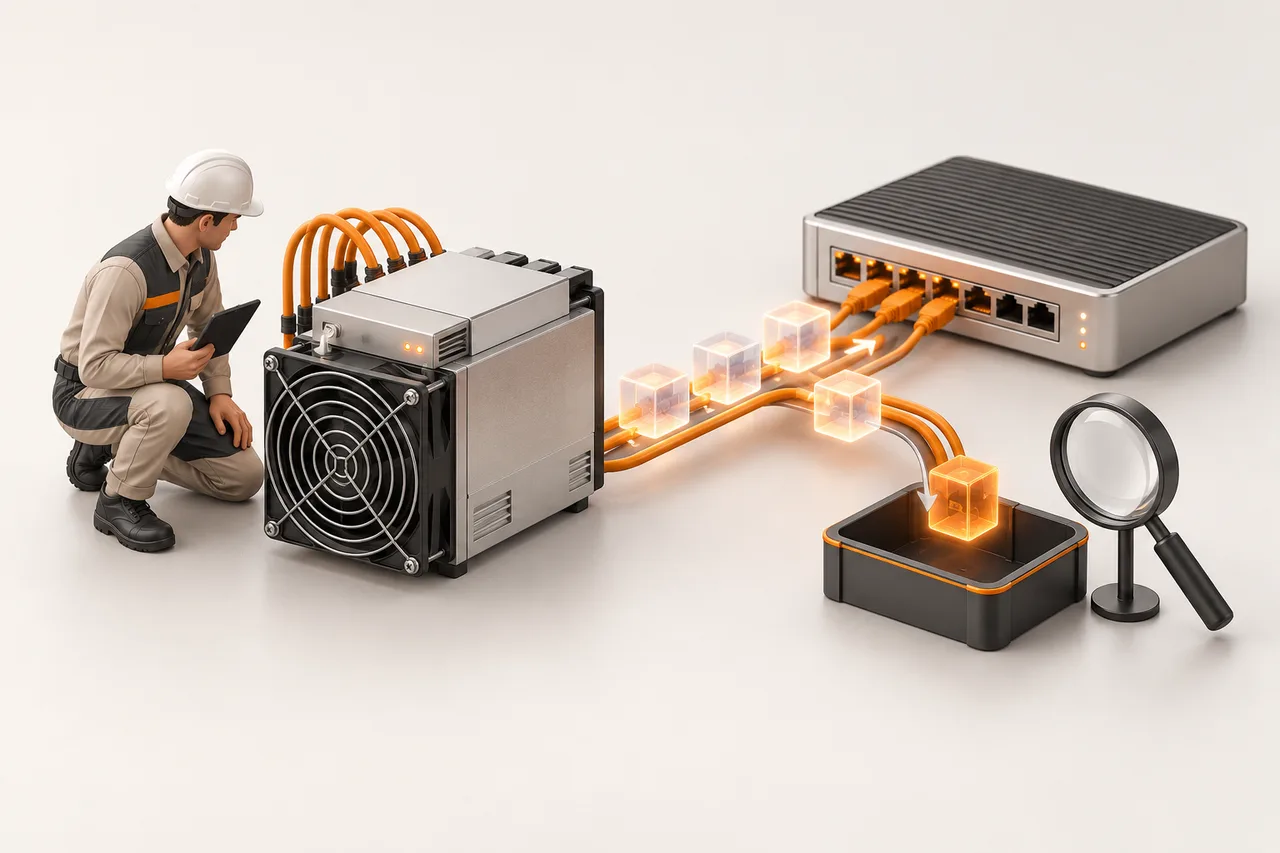
Confirm the configured endpoint against the pool’s official instructions, then inspect disconnect frequency and response times over the problem period. A nearby server name does not guarantee a stable route. If testing another supported endpoint, keep the same device settings and log the change time. Avoid changing pool, firmware and frequency simultaneously.
Check local stability when errors persist
If several workers on one network fail together, investigate shared infrastructure. If only one machine is affected, compare its logs, cooling and mode with a known-good peer of the same model. Return experimental tuning to a validated configuration before judging hardware. Use model-specific support steps; a pool discrepancy alone does not establish a damaged board.
Close the case with a before-and-after record
In a hypothetical case, local hashrate stays stable while repeated WAN reconnects coincide with stale work. After fixing the connection, compare equivalent periods and record accepted work, rejection rate and reconnect count. Improvement after a change supports the diagnosis, but a very short quiet interval is weak evidence. Attach both periods when escalating to the pool or supplier.
References
Original documents and further reading. Check the manual for your exact equipment.