
On this page
Give every number a unit
Hashrate describes attempts per second; watts describe electrical power. Keep the algorithm alongside hashrate: a SHA-256 TH/s figure cannot be ranked directly against a Scrypt GH/s figure. Within one algorithm, normalize the prefix before comparing. A quotation that says only “200” has not yet specified a useful performance target.
| Unit | Meaning |
|---|---|
| TH/s | 1 TH/s = 1,000 GH/s |
| PH/s | 1 PH/s = 1,000 TH/s |
| kW | 1 kW = 1,000 W |
| kWh | Energy: kW × operating hours |
Calculate efficiency on the same basis
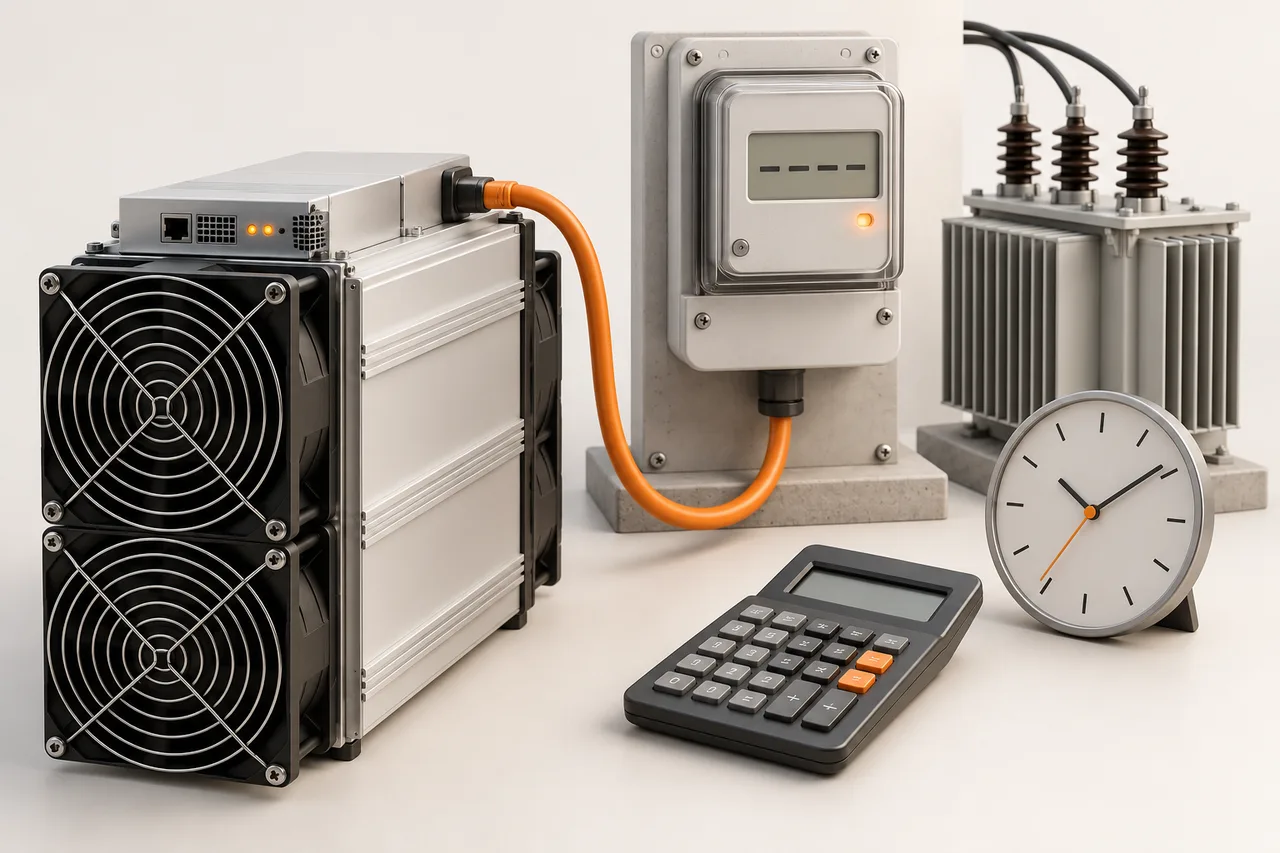
For SHA-256 equipment rated in TH/s, watts divided by TH/s gives J/TH. In an illustrative example, 3,500 W divided by 200 TH/s is 17.5 J/TH. A lower value uses less energy per unit of work under those conditions. It does not by itself say which purchase has the better overall outcome.
Keep mode and measurement together
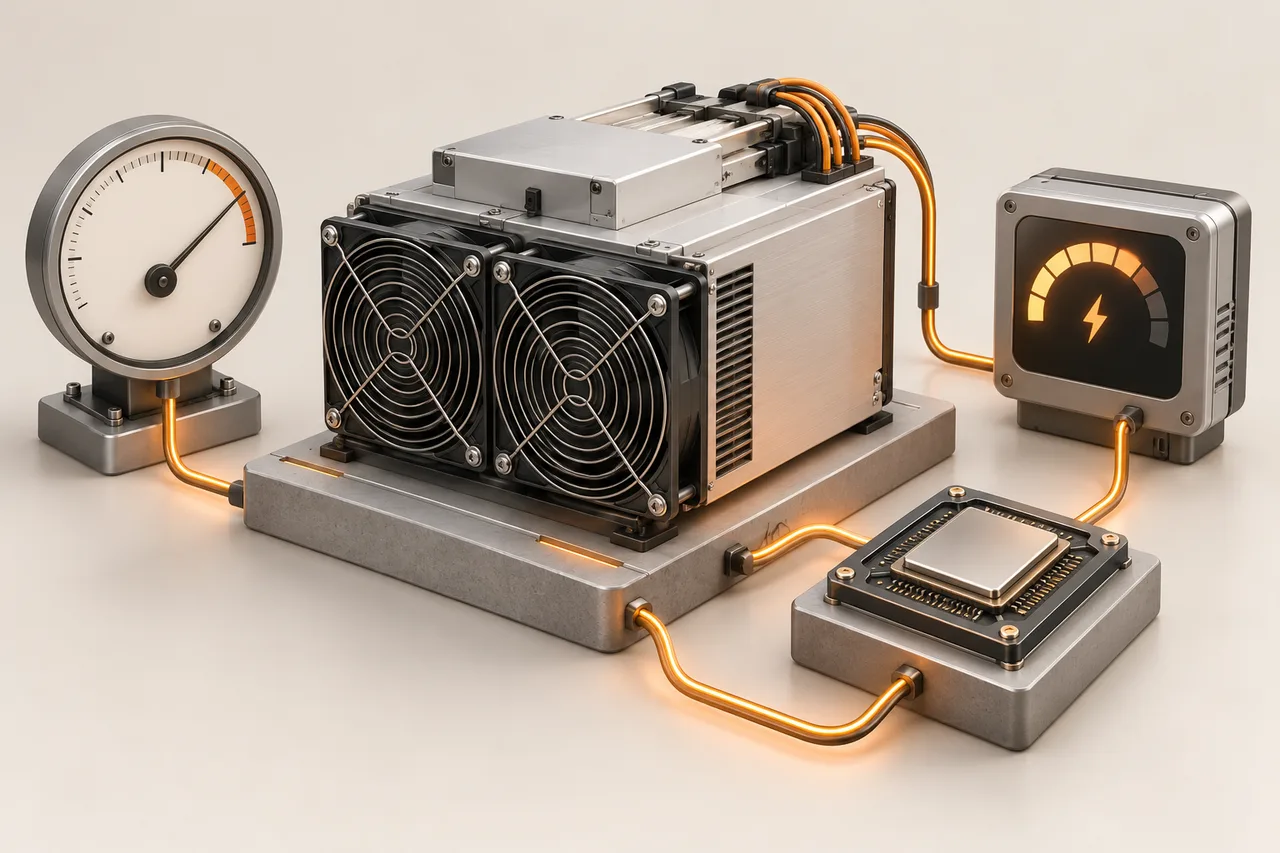
Do not combine the hashrate of a performance mode with the power of an efficiency mode. Record firmware, ambient conditions, cooling configuration and whether power includes the supply losses. Keep published nominal values separate from your own measurements. A useful comparison sheet leaves unknown cells blank rather than combining incompatible specifications.
- Record exact model, algorithm and operating mode.
- Record hashrate and power from the same test window.
- Add auxiliary equipment as a separate power line.
Compare local and pool averages carefully
The device dashboard and the pool do not necessarily measure over the same time window. Pool-side hashrate is estimated from submitted work and can fluctuate, especially over short periods. Compare longer matching windows, uptime and rejected work before concluding that hardware is underperforming. Keep the observation period in your record.
Check useful work alongside nameplate efficiency
Suppose two units have similar local hashrate and power but one reconnects repeatedly. Its delivered work can be lower even if the displayed J/TH looks competitive. Use matched-time pool work as an operational cross-check, then investigate the reason for lost production. Keep device efficiency and site delivery quality as separate measurements so a network problem is not mistaken for a chip-efficiency problem.
Evaluate operating modes with a controlled trial
For each supported mode, record stable hashrate, wall power, cooling demand and rejected work. Keep ambient conditions and the observation period comparable. Calculate energy per delivered work from the measured result, not only the mode label. A lower-power mode may suit one electricity scenario while a higher-output mode suits another; rerun the cost worksheet using actual values.
References
Original documents and further reading. Check the manual for your exact equipment.