


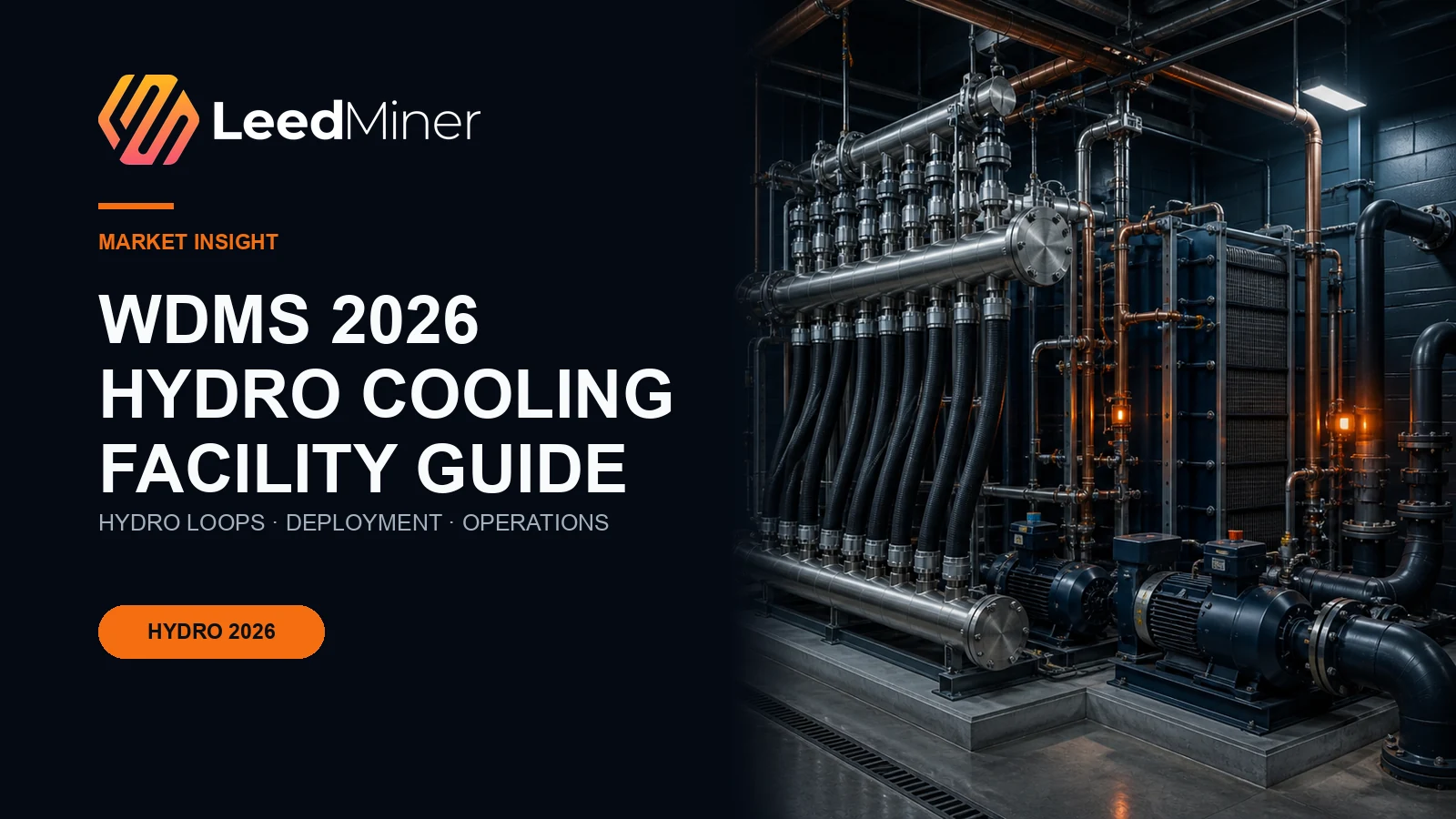
BITMAIN’s 2026 summit theme makes one point clear: hydro cooling is no longer only a miner specification. It is a facility decision. The official World Digital Mining Summit 2026 page lists the Hong Kong event for August 27–28 under the theme “Ride the Cycle. Hydro Prevails.” For operators, the useful question is not which slogan wins. It is whether power distribution, coolant quality, heat rejection, controls, maintenance access and deployment timing are engineered as one system.
This guide translates that signal into an operating checklist. It uses BITMAIN’s official product and support documentation for technical facts, while LeedMiner product pages are used only for current catalog availability and approved media. No equipment sales prices appear in this article.
Key takeaways: treat the water loop as production infrastructure; size heat rejection for actual site conditions; document coolant chemistry and winter procedures; plan redundancy and service isolation; and select a site-built, modular container solution or hosted deployment according to the team’s real operating capacity.
What WDMS 2026 signals about hydro cooling
BITMAIN’s event page highlights hydro-cooling innovation alongside renewable energy and the proof-of-work ecosystem. Its company history also records the S23 Hyd. as the generation that moved the company’s stated efficiency metric into single-digit joules per terahash, followed in 2026 by the ANTSPACE HW7 hydro container. Together, those announcements frame hydro cooling as a stack: silicon efficiency, electrical delivery, coolant circulation, heat rejection and repeatable deployment.

The official BITMAIN company history is important because it places a high-efficiency miner and a hydro container on the same technology timeline. An efficient server can reduce the heat produced per unit of hashrate, but its total electrical load still becomes heat that the facility must remove. The operator therefore needs a design point for ambient temperature, coolant inlet temperature, flow, pressure, elevation, water quality and expected fouling—not a generic cooling claim.
Hydro systems also shift where operational risk appears. Air-cooled sites focus heavily on airflow, filtration and fan replacement. A hydro site adds pumps, seals, valves, hoses, heat exchangers, coolant treatment, freeze protection and leak response. The benefit is controlled heat transfer and high power density; the tradeoff is that the cooling plant becomes a shared production dependency.
A procurement comparison should separate three layers. First, verify the exact miner version and its rated electrical and coolant envelope. Second, confirm the facility loop can maintain that envelope during the hottest and coldest expected conditions. Third, define how the system behaves when a pump, sensor, valve, network connection or heat-rejection unit fails. A strong efficiency number is valuable, but recoverability determines whether it becomes reliable hashrate.
Design the water and power system around the miner
BITMAIN’s official S23 Hyd. product manual specifies the 580 TH/s version at a typical 5,510 W and 9.5 J/TH, with three-phase 380–415 V input. It also defines an inlet-coolant range of 20–50°C, flow of 8–10 L/min, maximum coolant pressure of 3.5 bar and permitted coolant types. Those values are engineering boundaries, not optional brochure details.
Start with a heat balance. Sum the rated miner load, power-supply losses, pump power and reasonable operating margin. Then verify that dry coolers, cooling towers or a secondary water loop can reject that heat at the site’s design ambient temperature. Nameplate capacity at a mild test condition is not enough. Ask for performance curves at the actual approach temperature, fluid mixture and elevation.
Next, design hydraulic balance and isolation. Every branch needs a documented target flow, a way to measure it and valves that let technicians service one segment without draining the whole deployment. Strainers, filters and water treatment must have defined inspection intervals. Pump redundancy should include automatic changeover testing, not merely a spare pump installed beside the active one. Place leak detection where water would actually travel, and connect critical alarms to the same monitoring and escalation process used for power and network incidents.
Coolant quality is a production variable. BITMAIN’s official hydro-miner support guidance says municipal tap water should not circulate directly and describes low-temperature startup protection. It also notes that a hydro miner requires specialized heat-dissipation equipment. Operators should document fill water, inhibitor or antifreeze concentration, conductivity or other required chemistry checks, sampling frequency, top-up procedure and contamination response. In cold climates, shutdown and storage procedures must prevent trapped liquid from freezing.
Electrical design must be equally specific. Confirm voltage, phase, conductor sizing, breaker coordination, earthing, connector type and safe isolation. Reserve capacity for pumps and heat rejection rather than allocating the entire service to miners. Sequence the controls so coolant flow and temperature are proven before miners start, and so an out-of-range condition produces an orderly shutdown instead of equipment damage.
Antminer S23 Hyd 580 TH/s

Hydro cooling · 5,510 W · 9.5 J/TH · In stock
Antminer S21 XP Hyd 473 TH/s

Hydro cooling · 5,676 W · 12 J/TH · In stock
Choose a deployment model your team can operate
A site-built hydro plant offers the most flexibility, but it also requires coordinated civil, electrical, hydraulic and controls engineering. A modular approach can compress design and commissioning when the power block, cooling block and miner population are standardized. Hosting moves more of that operating burden to a specialist. The best choice is the one that makes responsibilities, interfaces and failure response explicit.
For a site-built project, require stamped drawings where applicable, a controls narrative, commissioning scripts and a spare-parts plan. The team must own water treatment, pump maintenance, heat-rejection cleaning, freeze protection and emergency response. This model fits experienced operators with a stable site and a reason to customize the loop.
A container solution is useful when schedule and repeatability matter. Confirm the supported miner models and quantities, electrical input, external heat-rejection requirement, coolant specification, operating temperature range, fire and leak controls, transport dimensions, crane or foundation needs and service clearances. Treat the container boundary as an interface, not the end of engineering: the site still supplies reliable power, networking, water-side or air-side heat rejection and safe access.
Hosting may fit buyers who want hydro hardware exposure without building a cooling plant. Review metering, uptime definitions, curtailment rules, maintenance scope, parts approval, pool access, insurance, termination rights and how quickly the operator responds to coolant alarms. Ask for evidence from the exact facility and cooling architecture that will receive the machines.
Before committing, run a design review with one owner for each interface: grid connection, transformer and switchgear, miner branch circuits, coolant loop, heat rejection, controls, network, fire response, drainage and environmental permissions. Convert every open assumption into a named action, due date and acceptance test. The summit theme points toward hydro cooling; disciplined commissioning determines whether it performs.