


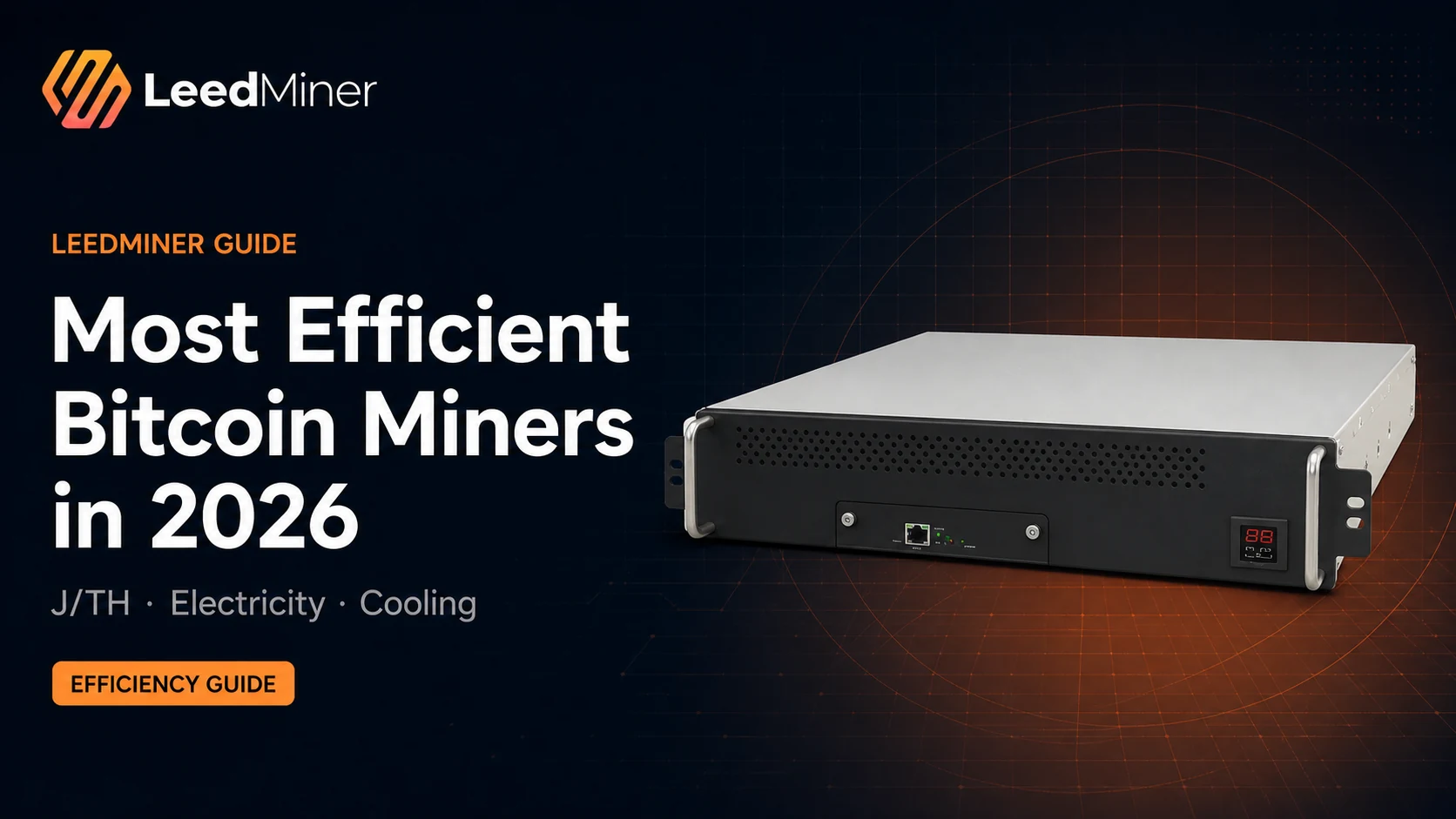
Bitcoin miner efficiency in 2026 is not simply a race for the highest hashrate. The best machine for a specific operation is the one that converts electricity into useful hashrate at a cost the site can support, with cooling and electrical infrastructure that remain stable under continuous load. For most buyers, that means comparing joules per terahash (J/TH) first, then calculating the miner's real daily electricity cost and checking whether its cooling system fits the deployment.
This guide is for buyers comparing current SHA-256 miners for a home, hosting site, farm expansion or container deployment. It uses current LeedMiner catalog examples, but prices and availability can change; always confirm the live product page before ordering.
Quick answer: what makes a Bitcoin miner efficient?
A Bitcoin miner is efficient when it delivers more terahashes per second with less electrical energy. The standard metric is J/TH: lower J/TH is better. A 10 J/TH miner theoretically uses about half as much energy per unit of hashrate as a 20 J/TH miner. That advantage compounds every hour the machine runs.
Efficiency alone is not the whole decision. A miner can have an excellent J/TH rating but still be a poor fit if the facility lacks the required voltage, water loop, dry cooler, rack space or heat rejection capacity. Use this order of evaluation:
- Compare J/TH and hashrate.
- Calculate daily electricity consumption and cost.
- Confirm voltage, cooling and environmental requirements.
- Compare purchase price, availability and delivery timing.
- Model revenue and downside scenarios with a profitability calculator.
You can start with the LeedMiner ASIC miner catalog, then place up to five candidates in the ASIC comparison tool.
How to calculate ASIC electricity cost
The calculation is straightforward:
Daily energy (kWh) = power in watts ÷ 1,000 × 24
Daily electricity cost = daily energy × electricity rate per kWh
For example, the listed 5,510 W power draw of the Antminer S23 Hyd 563T equals approximately 132.24 kWh per day. At $0.05/kWh, electricity costs about $6.61 per day. At $0.08/kWh, it rises to about $10.58 per day. That $3.97 daily difference becomes roughly $1,449 over a year before downtime, pool fees or maintenance.
This is why the same miner can be attractive at one location and uneconomic at another. Test your own rate in the LeedMiner profit calculator, and use a conservative rate instead of the lowest promotional quote you have received.
Current efficiency examples from the LeedMiner catalog
The following products illustrate how efficiency, power and deployment type interact. Specifications and displayed prices are snapshots from the live catalog on August 5, 2026.
| Miner | Hashrate | Power | Listed efficiency | Cooling | Displayed price |
|---|---|---|---|---|---|
| Antminer S23 Hyd 563T | 563 TH/s | 5,510 W | 9.5 J/TH | Hydro | $12,892.70 |
| Antminer S21j XP Hyd | 495 TH/s | 5,940 W | 12 J/TH | Hydro | $5,989.50 |
| WhatsMiner M7D | 652 TH/s | 9,454 W | 14.5 J/TH | Hydro, 2U | $5,607.20 |
| WhatsMiner M6DS++ | 610 TH/s | 9,455 W | 15.5 J/TH | Hydro, 2U | $4,331.00 |
| WhatsMiner M6DS+ | 556 TH/s | 9,452 W | 17 J/TH | Hydro, 2U | $3,669.60 |
The table is not a universal ranking. The Antminer S23 Hyd has the lowest listed J/TH in this group, while the WhatsMiner M7D provides more total hashrate and a rack-oriented 2U form factor. The lower-priced M6DS models may reduce initial capital cost, but their higher J/TH increases energy cost per unit of hashrate.
A disciplined buyer should compare the total operating plan, not only the first number that looks attractive.
J/TH versus total power: why both matter
J/TH measures efficiency per unit of hashrate. Total power measures the load the facility must actually supply and cool. Two miners can have similar economics per terahash but very different infrastructure requirements.
The WhatsMiner M7D is listed at 9,454 W. That is about 226.9 kWh per day, or approximately $11.35 per day at $0.05/kWh. A facility installing 100 units would be planning for roughly 945 kW of miner load before pumps, cooling equipment, networking and safety margin. The electrical design therefore matters as much as the spreadsheet calculation.
Before buying, confirm:
- Service voltage and acceptable operating range.
- Continuous circuit capacity and distribution design.
- Hydro loop flow, inlet temperature and pressure requirements.
- Dry-cooler or cooling-tower capacity at the site's hottest design condition.
- Space, rack loading, piping access and maintenance clearance.
- Additional facility power usage, often described through power usage effectiveness.
For deployments that need integrated infrastructure, review container solutions and confirm compatibility before combining miners and cooling equipment.
Air cooling or hydro cooling?
Air-cooled miners are easier to deploy at small scale because they do not require a water loop. They do, however, move a large volume of hot air and typically produce significant fan noise. Air cooling can work well when the site has strong ventilation, clean intake air and a reliable plan for separating hot and cold airflow.
Hydro-cooled miners remove heat through a liquid loop and can support higher-density layouts. They usually reduce miner-fan noise, but the complete system is more complex. Pumps, heat exchangers, dry coolers, water quality, leak control and winter protection all become part of the operation. Hydro is most compelling when the infrastructure is designed as a system rather than assembled after the miners arrive.
Neither method is automatically better. Choose the cooling architecture that the site can operate consistently. A slightly less efficient miner running steadily can outperform a headline-efficient machine that is frequently throttled or offline.
A practical buying framework
1. Start with your electricity rate
Use the fully loaded energy price, including demand charges or service fees where applicable. Run at least three cases: expected, higher-cost and stress.
2. Set the infrastructure limit
Document available kW, voltage, cooling type, heat rejection and physical capacity. This removes machines that look good on paper but do not fit the site.
3. Compare efficiency and capital cost together
Calculate the price difference between two miners and the daily energy savings of the more efficient option. Dividing the price premium by daily savings gives a simple energy-only payback period. This does not replace a full profitability model, but it reveals whether you are overpaying for a small efficiency gain.
4. Check product identity and delivery terms
Confirm the exact model, hashrate variant, condition, warranty status, location and expected delivery batch. Small naming differences can represent materially different power and price values.
5. Plan for operations, not only installation
Budget for spare parts, pool fees, scheduled cleaning, firmware management, technician access and downtime. If you prefer a managed environment, compare available hosting locations and review the service agreement directly with the provider.
Common mistakes when comparing efficient miners
Choosing by hashrate alone. Higher hashrate increases gross output, but power rises as well. Compare J/TH and daily energy cost.
Using a temporary electricity discount as the base case. Model the rate you expect over the useful operating period.
Ignoring cooling auxiliary power. Pumps, fans and heat-rejection equipment consume energy that is not always included in miner specifications.
Mixing variants. A model family may contain several hashrate, power and delivery options. Match the price to the exact variant.
Treating displayed income as guaranteed. Network difficulty, transaction fees, uptime, pool performance and Bitcoin price change. Use live estimates as inputs, not promises.
Frequently asked questions
What is a good J/TH for a Bitcoin miner in 2026?
There is no single cutoff for every site, but lower is better. Current high-efficiency hydro models in the LeedMiner catalog reach the low-teens or below, while other viable machines trade some efficiency for lower purchase price or a different form factor. Compare the energy savings against capital cost and infrastructure requirements.
Is the miner with the lowest J/TH always the most profitable?
No. Profitability also depends on purchase price, electricity rate, hashrate, uptime, delivery timing, cooling cost, network conditions and Bitcoin price. J/TH is an essential filter, not a complete profitability result.
How much does electricity price change the result?
The effect is linear: every $0.01/kWh change is multiplied by the miner's daily kWh consumption. A 5,510 W miner uses about 132.24 kWh per day, so each $0.01/kWh adds approximately $1.32 per day.
Should a small buyer choose hydro cooling?
Only when the required loop, heat rejection, electrical service and maintenance plan are already available or included in a professionally designed package. Air cooling is often simpler at small scale, while hydro becomes attractive for controlled, higher-density deployments.
Final checklist
The most efficient Bitcoin miners in 2026 are the machines that combine low J/TH with a deployment your site can operate reliably. Shortlist by efficiency, calculate real daily kWh, verify cooling and voltage, then compare capital cost and delivery terms.
Use the miner catalog to review current models, test selected candidates in the comparison tool, and run your own electricity rate through the profitability calculator. For a product or infrastructure check, send LeedMiner the exact model, quantity, destination and available power details so the quote matches the real deployment.