
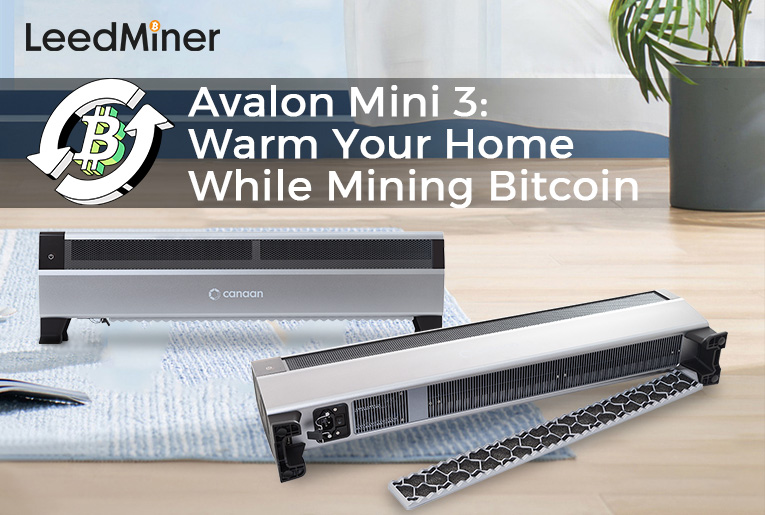
The Canaan Avalon Mini 3 combines SHA-256 computing with the form and thermal purpose of a residential baseboard heater. That makes it different from a conventional home ASIC placed in a garage or utility room: its 800 watts of electrical input become useful indoor heat while the machine contributes hashrate to a Bitcoin mining pool.
This does not make heating free, and it does not guarantee mining profit. It changes the comparison. A buyer who already needs electric resistance heat can evaluate the Mini 3 as both a heater and a miner, provided the room, circuit, network, noise tolerance, pool setup, and local electricity rate are suitable.
Avalon Mini 3 specifications
Canaan's official Avalon Mini 3 product page lists the following core specifications:
| Specification | Official figure |
|---|---|
| SHA-256 hashrate | 37.5 TH/s |
| Power | 800 W |
| Efficiency | 21.3 J/TH |
| Input | 110–240 V AC, 50/60 Hz |
| Noise | 35–55 dB, depending on mode and conditions |
| Net dimensions | 760 × 104 × 214.5 mm |
| Net weight | 8.35 kg |

The manufacturer describes Heater, Mining, and Night operating modes. Heater mode prioritizes temperature control, Mining mode prioritizes computing output, and Night mode reduces noise for quieter operation. Canaan also describes tip-over power protection and an IP22 rating for limited protection against accidental splashes. These features do not replace the installation and safety instructions supplied with the unit.
How Bitcoin mining becomes room heat
Almost all electricity consumed by computing hardware eventually becomes heat in the room or cooling medium. A conventional 800 W resistance heater also turns approximately 800 W of electricity into heat. The Mini 3 uses that electricity first to run ASIC chips, fans, controls, and networking; the resulting thermal energy is then delivered into the room.

The heating output should therefore be evaluated as an 800 W class heat source, not as a replacement for a whole-home furnace. Canaan reports that, in its own test, the highest Heater setting raised a 10-cubic-meter space from 15°C to 21°C in about ten minutes. Room size, insulation, outdoor temperature, air leakage, furnishings, and placement can produce very different results. Treat the manufacturer's test as a defined laboratory scenario rather than a universal promise.
For buyers comparing electric heaters, the key distinction is not thermal efficiency. Both devices ultimately produce heat from electricity. The distinction is that the Mini 3 performs SHA-256 work and may generate Bitcoin revenue while operating.
Electricity cost and heat-credit accounting
At 800 W, continuous operation uses:
- 0.8 kWh per hour;
- 19.2 kWh per day;
- approximately 576 kWh in a 30-day month.
At $0.10/kWh, that is about $1.92 per day or $57.60 per 30 days. At $0.20/kWh, the same usage is about $3.84 per day or $115.20 per 30 days. These figures cover electricity only and do not include taxes, demand charges, pool fees, shipping, maintenance, or equipment cost.
Avoid counting the same energy benefit twice. If the Mini 3 replaces an 800 W electric heater that would otherwise run for the same hours, the relevant incremental energy cost of mining may be small during the heating season. If the room does not need heat, the full electricity cost and any cooling or ventilation cost belong in the mining model.
Use the LeedMiner profit calculator with the current network and market assumptions, then compare the result with your actual utility bill. Hashprice, difficulty, Bitcoin price, pool luck, fees, uptime, and firmware settings change. A profitability screenshot is not a fixed return.
Noise, placement, and room comfort
The official noise range is 35–55 dB. Canaan's 35 dB figure comes from a stated test at 25°C with Heater mode set to 500 W. Full mining output, a warmer room, restricted airflow, or a higher fan speed may be more noticeable.
Before choosing a bedroom, office, living room, or workshop location, consider:
- distance from beds, desks, and seating;
- vibration transmission through floors or furniture;
- unrestricted intake and exhaust clearance;
- access to a grounded wall circuit;
- Ethernet routing and cable trip hazards;
- children, pets, curtains, dust, and accidental contact;
- whether continuous fan noise is acceptable at night.
Do not enclose the device to reduce sound. Enclosures can trap heat, restrict airflow, and create a safety risk. Follow Canaan's clearance, electrical, moisture, and operating-temperature instructions.
Circuit planning for an 800 W continuous load
Eight hundred watts is modest compared with many industrial miners, but continuous operation still deserves a circuit check. At 120 V, the nominal current is roughly 6.7 A; at 230 V, it is roughly 3.5 A. Actual current and safe circuit loading depend on supply voltage, wiring, other devices on the branch circuit, local electrical code, and the unit's operating mode.

Use a properly grounded outlet and avoid overloaded extensions or power strips. Inspect the outlet, plug, and cable for heat or discoloration during early operation. If the circuit also serves a microwave, kettle, portable air conditioner, or another heater, ask a qualified electrician to verify the load. Never defeat grounding or protective devices.
Network and pool setup
The Mini 3 needs an internet connection and a mining-pool account to convert hashrate into credited work. The product supports Ethernet, which is generally preferable for continuous operation because it avoids Wi-Fi congestion and signal changes.
A practical setup sequence is:
- place the unit with correct clearance and stable footing;
- connect Ethernet to a trusted local network;
- power the device from the verified circuit;
- access the management interface using the official setup method;
- enter the pool URL, worker name, and required credentials;
- update only with firmware obtained through a verified Canaan channel;
- confirm hashrate, accepted shares, temperature, fan behavior, and power mode;
- change default credentials and isolate the device from sensitive home systems where possible.
Record the serial number, firmware version, pool settings, purchase documents, and warranty information. Never expose the management interface directly to the public internet.
When the Mini 3 makes the most sense
The strongest use case is a cold-season room that already needs steady electric heat, has a suitable circuit and wired network, and can tolerate the operating sound. In that setting, the owner can value the heat first and treat mining revenue as an offset that changes over time.
It is a weaker fit when:
- the climate rarely requires heating;
- local electricity is expensive;
- the room needs near-silent operation;
- the only available circuit is heavily shared;
- the buyer expects industrial-scale Bitcoin output;
- ventilation or safe placement is difficult;
- the purchase depends on a fixed payback date.
Thirty-seven and a half terahashes per second is meaningful for a compact home device, but it remains a small share of the Bitcoin network. Pool mining usually provides more regular credited payouts than solo mining, although all pool terms and fees should be reviewed.
Current LeedMiner product card
The following listing was published and in stock when checked on August 12, 2026. Price and availability can change; confirm the live page and request a dated quotation before ordering.
Product card — Canaan Avalon Mini 3 (37.5 TH/s) Listed at $819.00 with 800 W power, 110–240 V input, and SHA-256 support. View the Avalon Mini 3
If a live listing has no displayed price, label it Inquiry and request a quotation. Do not use “Pending” for missing commercial information.
Buyer checklist
Before purchasing, confirm:
- electricity price and seasonal heating hours;
- outlet voltage, grounding, circuit capacity, and plug compatibility;
- acceptable noise for the intended room;
- dimensions and required airflow clearance;
- Ethernet availability;
- pool availability and payout threshold;
- shipping origin, taxes, warranty, and after-sales route;
- whether the device will still have a useful location outside winter;
- the downside case if mining revenue falls.
Verdict
The Avalon Mini 3 is best understood as a controlled home-heating appliance that also performs Bitcoin mining, not as a miniature industrial farm. Its 37.5 TH/s hashrate, 800 W input, operating modes, and baseboard form make it relevant for buyers who can genuinely use the heat. The economic case becomes weaker when heat is unwanted or electricity is costly.
Compare the Mini 3 with other Bitcoin miners and the ASIC comparison tool, then contact LeedMiner with your country, voltage, electricity price, room size, preferred noise level, and heating season for a dated product and delivery check.