


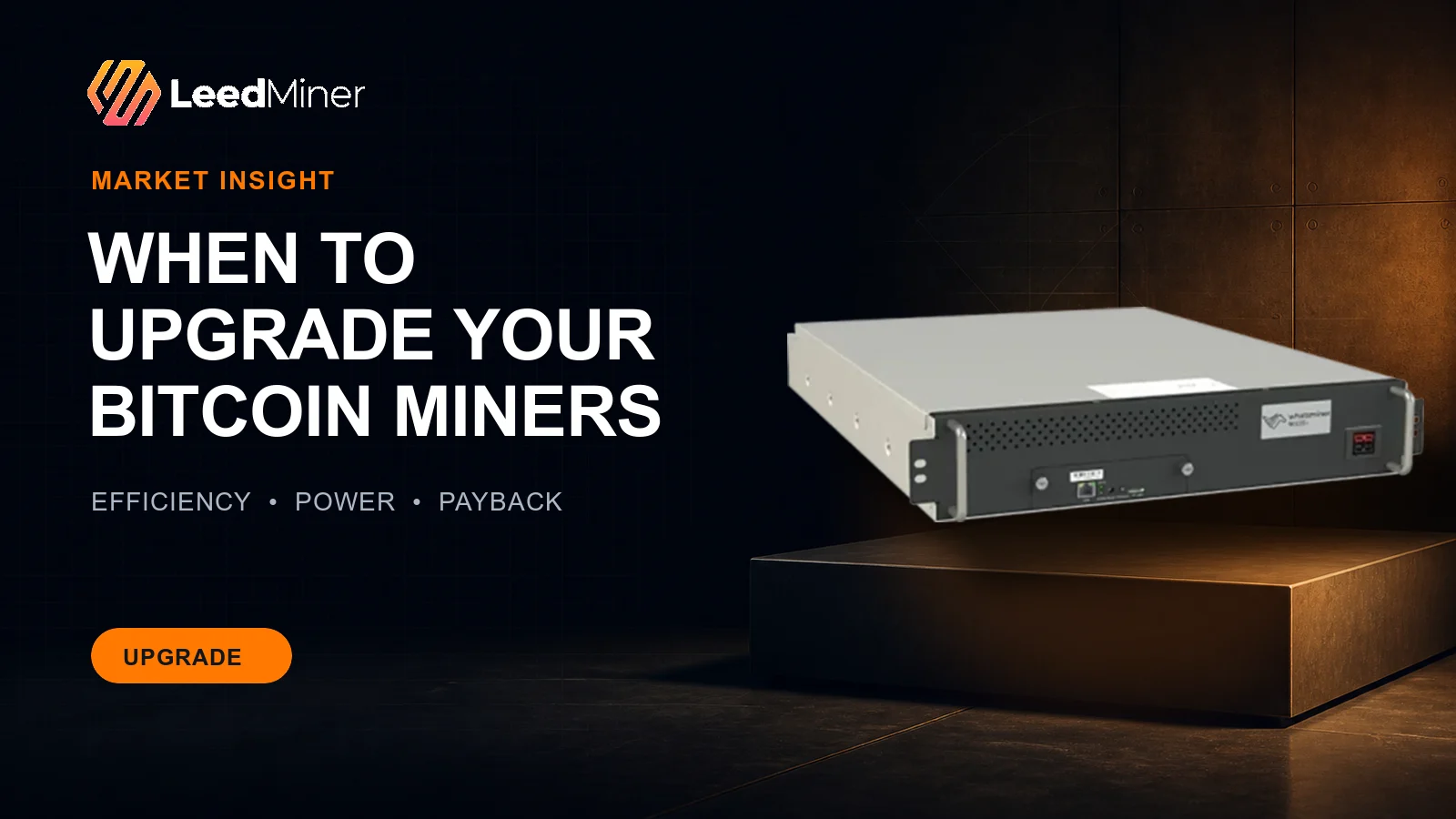
Bitcoin mining hardware does not become obsolete on a fixed calendar. A miner can remain useful for years at a low-cost, well-cooled site, while the same machine may become a cash-flow problem quickly where electricity is expensive or curtailment is frequent. The practical question in 2026 is therefore not “What is the newest ASIC?” but “Does replacing this fleet improve risk-adjusted cash flow enough to justify the capital?”
This guide turns that question into a repeatable buy, hold or upgrade framework. It focuses on the variables an operator can verify: energy cost, joules per terahash, uptime, network difficulty, cooling capacity, resale value and deployment timing. Revenue estimates change continuously, so use live data and conservative scenarios before ordering equipment.
Quick answer: buy, hold or upgrade?
Buy when you have confirmed power, cooling and delivery capacity, and the new machine remains cash-flow positive in a conservative scenario.
Hold when the installed fleet still covers its variable operating cost, the infrastructure is stable and the payback from replacement is too slow after freight, downtime and retrofit costs.
Upgrade when the energy savings and additional hashrate create a credible payback inside your investment horizon, or when older hardware creates reliability, density or maintenance constraints that the new fleet solves.
The decision should be made at the site level, not from a public profitability screenshot. Start with the LeedMiner profit calculator, compare candidates in the ASIC comparison tool, and then replace headline assumptions with your own contract and operating data.
Signal 1: your all-in electricity cost
Electricity is the first filter because ASICs run continuously. The correct input is the all-in marginal cost per kWh, including energy, delivery, demand charges, taxes and any site-specific fees that change with miner load. The U.S. Energy Information Administration publishes monthly electricity price data, but its averages are a benchmark rather than a substitute for your utility bill or power-purchase agreement. Use the EIA Electric Power Monthly to understand regional context, then model the rate actually available to your site.
Daily energy cost is:
Power in kW × 24 × electricity price per kWh
A 5.5 kW miner consumes about 132 kWh per day before pumps, dry coolers, ventilation and network equipment. At $0.05/kWh, miner-only electricity is about $6.60 per day; at $0.08/kWh, it is about $10.56. That difference is roughly $1,445 per year if the miner runs every day. Small changes in power price can therefore move an upgrade from attractive to uneconomic.
Model at least three power cases: contracted, realistic and stress. If the rate is seasonal, calculate monthly rather than using one annual average.
Signal 2: efficiency, not hashrate alone
Hashrate measures output; joules per terahash measure how much energy is required to produce that output. Lower J/TH is better. An upgrade can reduce cost per terahash even when the replacement miner draws more total power.
For example, moving from a 30 J/TH fleet to a 15 J/TH fleet roughly halves the miner energy required for the same hashrate. The facility may use the released electrical capacity to increase total hashrate without expanding its service connection. That density benefit can matter where transformers, switchgear, racks or cooling loops are the bottleneck.
Do not compare nameplate efficiency in isolation. Confirm the exact performance mode, voltage, inlet temperature and cooling configuration. Then include auxiliary power. A hydro miner with excellent nameplate J/TH still depends on pumps and heat rejection; an air-cooled miner depends on adequate ventilation and separation of hot and cold air.
Signal 3: the network is adjusting too
Bitcoin mining revenue per unit of hashrate changes with block subsidy, transaction fees, network difficulty and uptime. Difficulty is designed to adjust every 2,016 blocks so that block production returns toward the protocol target; the mechanism is documented in the Bitcoin Developer Guide. When more efficient hashrate joins the network, an unchanged miner may earn a smaller share even if the Bitcoin price is flat.
This does not mean every difficulty increase demands a purchase. It means an upgrade model should include multiple difficulty paths. Use a base case, a faster-growth case and a stress case. Avoid treating a single day of high transaction fees as permanent revenue.
The useful signal is fleet margin after power, not coin price alone:
Estimated mining revenue − electricity − pool fees − variable site cost
Track that figure per machine and per megawatt. A machine that remains slightly positive may still be worth holding if replacement capital is expensive. A machine with a stronger margin can still be a poor purchase if delivery arrives after the profitable window or the site is not ready.
Signal 4: replacement payback after every real cost
The simplest upgrade calculation is:
Net upgrade cost ÷ expected monthly cash-flow improvement = simple payback months
Net upgrade cost should include purchase price, freight, import charges, installation, electrical or cooling retrofit, commissioning downtime and spare parts, minus conservative resale proceeds from the old fleet. Monthly improvement should include both energy savings and the realistic revenue difference, not vendor maximums.
Run a downside case in which delivery is late, network difficulty grows faster and resale value is lower. If the upgrade only works in the optimistic case, the correct decision may be to hold cash or replace a smaller pilot batch first.
Signal 5: reliability and density
Not every upgrade is an efficiency trade. Operational problems can justify replacement before an older model reaches energy break-even:
- repeated hashboard or power-supply failures;
- unavailable parts or long repair queues;
- excessive technician hours per unit;
- thermal throttling during hot months;
- poor compatibility with the site's voltage or cooling design;
- too little hashrate per rack, container or transformer;
- restart instability after curtailment events.
Measure uptime from pool-side accepted hashrate, not only the miner dashboard. A theoretically efficient machine that is offline frequently can underperform an older, stable unit.
Current in-stock examples for an upgrade shortlist
These LeedMiner listings were in stock when reviewed on August 7, 2026. Prices and inventory can change; confirm the live page, condition, warranty, delivery batch and destination before purchase.
Product card — Bitmain Antminer S23 Hyd (580 TH/s) A high-efficiency hydro-cooled SHA-256 option for engineered liquid-cooling sites. Listed at $13,061.60 with 580 TH/s. Confirm loop flow, inlet temperature, voltage and heat-rejection capacity before ordering. View the Antminer S23 Hyd
Product card — WhatsMiner M7D (652 TH/s) A dense 2U hydro platform for rack-oriented deployments. Listed at $5,607.20 with 652 TH/s. Its high unit power makes rack, busway and staged-restart planning essential. View the WhatsMiner M7D
Product card — Canaan Avalon A15 Pro (221 TH/s) An air-cooled SHA-256 option that can suit incremental expansions where a hydro retrofit is not planned. Listed at $2,011.00 with 221 TH/s. Confirm airflow, noise and hot-air separation at the intended site. View the Avalon A15 Pro
The list is not a universal ranking. The correct choice depends on the infrastructure you already own and the operational risk you are prepared to take.
A disciplined upgrade workflow
1. Audit the existing fleet
Export 30–90 days of accepted hashrate, power use, faults, repair hours and curtailment. Group machines by model and performance mode.
2. Define the site constraint
Identify whether the limiting factor is kW, cooling, rack space, transformer capacity, noise, technician time or capital. An upgrade should solve the actual constraint.
3. Build comparable scenarios
Use the same Bitcoin price, fee, pool, uptime and difficulty assumptions for old and new machines. Separate miner power from facility overhead.
4. Add transition costs
Include removal, freight, customs, plumbing or duct changes, firmware setup, commissioning and lost production. Confirm whether the new miner can share existing infrastructure.
5. Pilot before a fleet-wide swap
Install a small batch, verify pool-side performance and measure the complete electrical and cooling load. A pilot can reveal compatibility issues before they affect an entire container or data hall.
6. Set a decision threshold
Choose a maximum payback period and minimum stress-case margin before reviewing offers. This prevents short-term market excitement from changing the investment rule.
When holding is the better decision
Holding can be rational when power is unusually cheap, the fleet is reliable, replacement infrastructure is unavailable or the resale market is weak. It can also be sensible when a site expects a power-contract change and needs better information before committing capital.
Holding should still be active management. Underclock during expensive hours where firmware and warranty terms permit, move maintenance into curtailment windows, improve airflow, repair rejected-share causes and track model-level profitability. “Do nothing” is not the same as operating the installed fleet well.
Final checklist
Before signing an ASIC purchase order, verify:
- the exact model, hashrate and performance mode;
- all-in power price and curtailment terms;
- service voltage, continuous capacity and protection;
- cooling compatibility and auxiliary power;
- conservative difficulty, fee and uptime assumptions;
- freight, tax, commissioning and downtime;
- warranty, parts and repair process;
- delivery timing and resale assumptions;
- payback under both base and stress cases.
An upgrade is attractive when it improves durable site economics, not merely when a new specification looks impressive. Use the miner catalog to build a shortlist, compare the candidates, and then contact LeedMiner with your destination, power rate, available kW, cooling method and current fleet. That information allows the quotation to reflect the site you actually operate.