


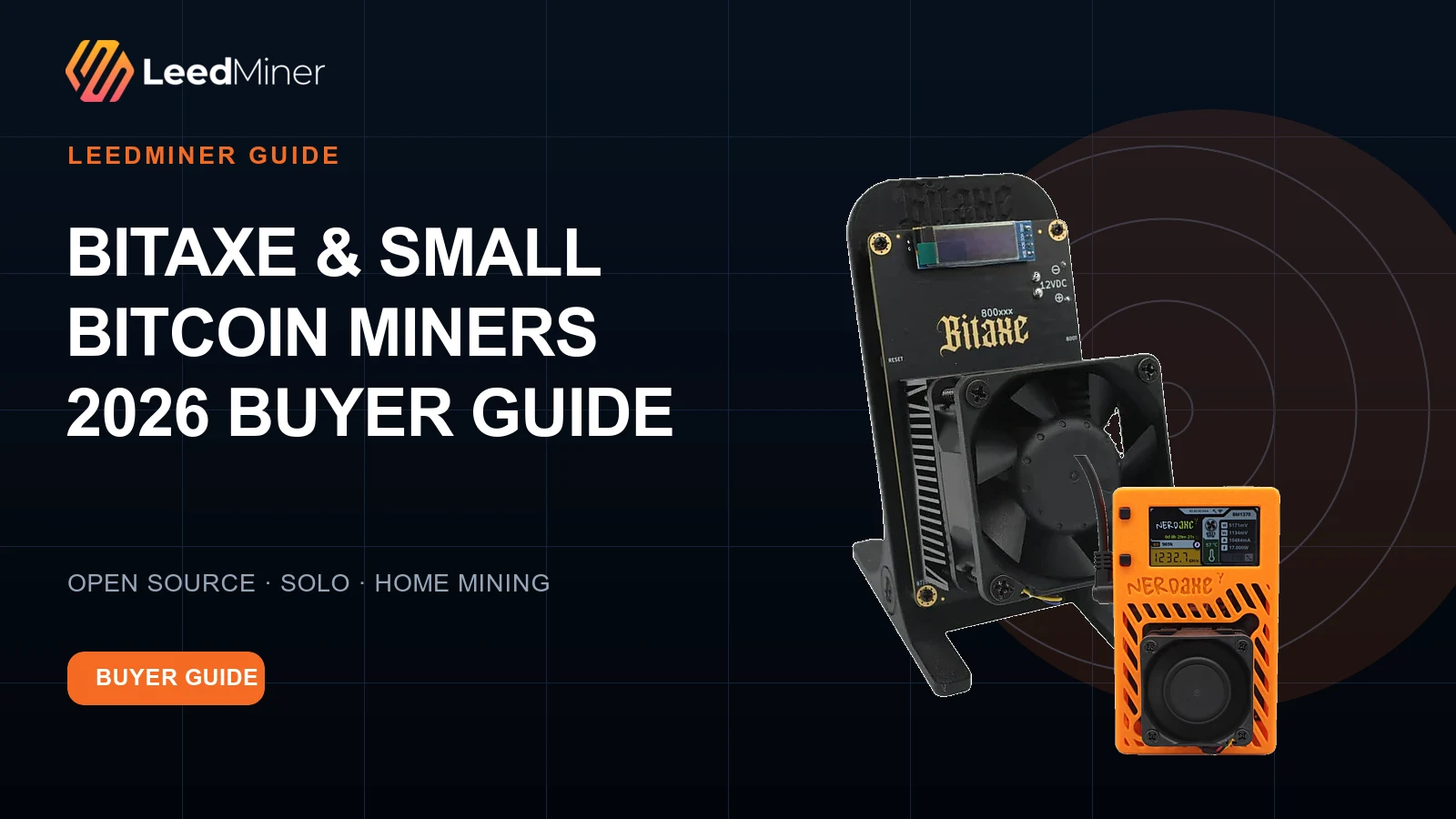
Small open-source Bitcoin miners have changed the entry point into SHA-256 mining. Instead of starting with a multi-kilowatt industrial ASIC, a buyer can learn pool configuration, firmware, cooling, telemetry and wallet hygiene on a desktop-scale device. The important distinction is purpose: a Bitaxe-class miner is a real ASIC miner, but it is normally bought for education, experimentation, decentralization or lottery-style solo mining—not as a substitute for an industrial fleet.
This 2026 guide explains how to compare Bitaxe and other small Bitcoin miners without confusing hashrate with guaranteed income. It uses the open-source Bitaxe project as the technical reference and current, published LeedMiner listings as practical buying examples.
What makes Bitaxe different?
Bitaxe is an open-source Bitcoin ASIC hardware project. Its official project organization publishes hardware design files, model-specific repositories and the ESP-Miner firmware used by AxeOS. The current family spans boards built around different generations of Bitmain SHA-256 chips, including the BM1366, BM1368 and BM1370. The official project overview is available at bitaxe.org, while the Bitaxe GitHub organization is the correct place to check designs, firmware activity and model lineage.
Open source does not mean every seller, enclosure or derivative is identical. A finished unit can differ in PCB revision, power stage, heatsink, fan, display, firmware build and assembly quality. Confirm the exact board revision and seller warranty instead of relying only on the word “Bitaxe.”
Solo mining, pool mining and realistic expectations
A small SHA-256 miner performs the same class of hashing work as a large Bitcoin ASIC, at a much smaller scale. It can point to a conventional pool for proportional rewards or to a solo-mining service or personal node setup. Pool mining produces small, frequent accounting entries according to the pool’s method. Solo mining has a very low probability of finding a block, with a highly irregular outcome.
Neither path guarantees recovery of the purchase price. Bitcoin difficulty, fees, pool rules, uptime, hardware settings and electricity cost all change. Treat a compact miner as a learning and participation device first. If the objective is commercial cash flow, compare industrial miners and site infrastructure separately in the LeedMiner ASIC comparison tool.
The five factors that matter most
1. Verified board and ASIC generation
Check the exact model number, PCB revision and ASIC. The official Bitaxe repositories document which chip family belongs to each hardware line. A product title that says “Gamma,” “Supra” or “GT” should still be reconciled with the seller’s photographs, firmware screen and board identifier. Avoid listings that mix photographs from multiple models.
2. Power supply and connector
Small power draw does not remove electrical risk. Confirm input voltage, connector polarity, current capacity and whether the power adapter is included. Use only the voltage specified for the exact board. An underrated adapter can overheat or cause unstable hashrate; an incorrect voltage can damage the board.
3. Cooling and operating profile
A compact ASIC still concentrates heat in a small area. Verify heatsink contact, fan operation, temperature telemetry and clear airflow. Overclocking may raise hashrate, but it also increases heat and power-stage stress. Start with the seller or project’s normal profile, watch temperature and rejected shares, and change one variable at a time.
4. Firmware provenance
The official ESP-Miner repository publishes the firmware source and release workflow. Use the project’s web flasher or a documented seller build, verify the target board, and save the original settings before updating. A firmware file for the wrong board can create a recovery job rather than an upgrade.
5. Network and pool configuration
Most compact miners rely on Wi-Fi, though exact connectivity varies. Use a stable local network, keep the management interface off the public internet and change default credentials where supported. Double-check the pool URL, worker name and payout address. A typo can send work to the wrong account or leave the device idle.
Three current LeedMiner options
The following listings were published and available for sale when checked on August 9, 2026. Price and stock can change; confirm the live page, included power supply, board revision and destination terms before ordering.
Product card — Bitaxe GT 800 (2.4 TH/s) Listed at $148.00 and in stock when checked. This is the higher-hashrate option in this shortlist. Confirm the exact GT 800 board, firmware target, input power and cooling assembly. View the Bitaxe GT 800
Product card — Nerdaxe Gamma 601 (1.2 TH/s) Listed at $105.00 and in stock when checked. A lower-cost desktop entry for learning AxeOS-style setup and SHA-256 pool configuration. Confirm whether the adapter and enclosure shown on the live page are included. View the Nerdaxe Gamma 601
Product card — Canaan Avalon Nano 3S (6 TH/s) Listed at $215.00 and in stock when checked. This is a manufacturer-designed compact alternative rather than a Bitaxe board. Canaan’s official listing specifies a compact air-cooled SHA-256 device; verify the current regional plug and operating mode. View the Avalon Nano 3S
Calculate electricity before buying
Use the same formula as for a large miner:
power in kW × 24 × all-in electricity rate = daily electricity cost
A device drawing 25 W uses 0.6 kWh per day; at $0.15/kWh that is about $0.09 per day before any network or auxiliary load. A 140 W device uses 3.36 kWh per day, or about $0.50 at the same rate. Small daily numbers become meaningful over a year, especially if several devices run continuously.
Do not estimate power from hashrate alone. Read the exact listing and firmware telemetry, then measure at the wall with suitable equipment. Use the LeedMiner profit calculator for scenarios, but keep the result separate from the educational value of the project.
Setup checklist
- Photograph the board label, power adapter and packaging before installation.
- Place the miner on a stable, nonflammable surface with unrestricted airflow.
- Verify input voltage and polarity before connecting power.
- Join a trusted local network and open the device dashboard from the LAN.
- Record the factory firmware version and configuration.
- Enter a verified pool URL, worker name and payout address.
- Run the stock profile first; watch hashrate, temperature, fan speed and rejected shares.
- Back up settings before any firmware or tuning change.
Common buying mistakes
The most common mistake is expecting a small miner to behave like a predictable investment product. Another is buying by headline hashrate while ignoring power quality, cooling and board revision. Buyers also confuse open-source lineage with a universal warranty: the project publishes designs, while the commercial seller remains responsible for the specific assembled unit and support terms.
Be cautious with unknown firmware downloads, public dashboard exposure and wallet requests. A miner needs a payout address or pool account details; it does not need the private keys or recovery phrase that control your funds.
Which small miner should you choose?
Choose a Bitaxe-style device if open hardware, firmware learning and community experimentation are the priority. Choose the higher-hashrate compact option if you accept more power and cooling demand. Choose a manufacturer-designed desktop miner if you prefer a more integrated appliance and official product documentation.
The best unit is the one whose exact hardware, power supply, cooling and support path you can verify. Browse LeedMiner’s published miner catalog, compare live specifications, and contact LeedMiner with your country, voltage, budget and intended use. Ask for a current quotation if any live product is marked Inquiry.