


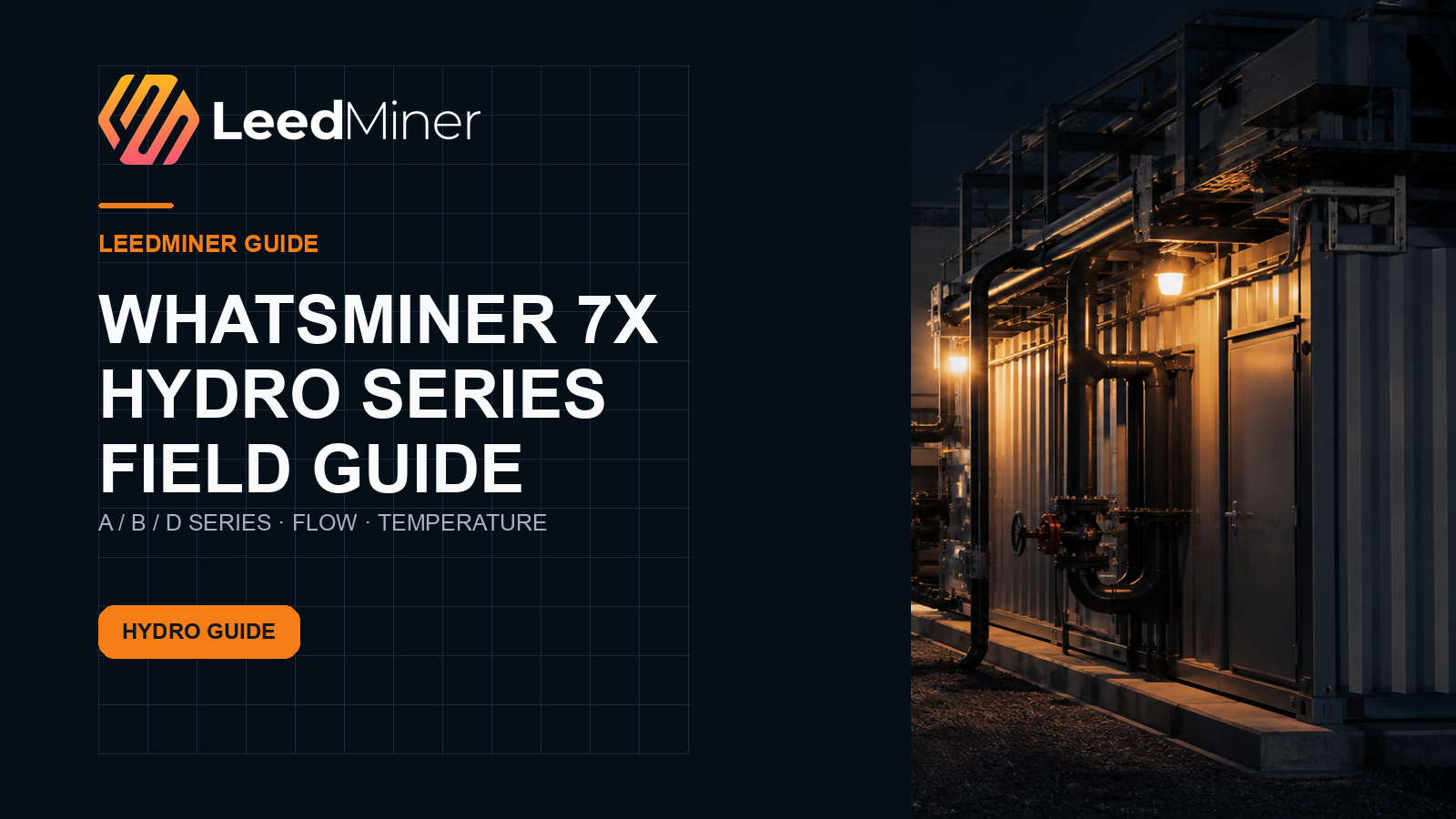
WhatsMiner’s 7X hydro-cooling family is not one interchangeable product class. The A, B and D series use different outlet-temperature limits, power modes and operating assumptions, so the cooling plant should be selected before a purchase order is finalized. A high outlet temperature can create a useful heat-recovery opportunity, while a fixed-power D-series fleet can simplify repeatable high-density blocks. Neither advantage matters if flow, switchgear, water quality and control logic are undersized.
This field guide translates current MicroBT guidance into a practical deployment workflow. The official July 2026 7X hydro-cooling overview is the primary source for A-, B- and D-series temperature and power boundaries. MicroBT’s separate D-series deployment note provides the published model ranges and container assumptions. Product examples below are limited to exact LeedMiner catalog records that are published, visible, in stock and media-ready. Equipment sales prices are intentionally absent.
Key takeaways
- A, B and D identify different thermal and operating envelopes, not cosmetic variants.
- MicroBT publishes about 1.3 liters per minute of coolant demand per 7D or 7DS machine and a fixed 9,200 W power level for the D series.
- The B series permits the highest published outlet temperature, but heat reuse still needs a secondary heat exchanger, controls and a real year-round heat sink.
- Electrical capacity, coolant flow, dry-cooler performance and restart sequencing must be sized together.
- Commission pumps and controls before energizing a full fleet, then document flow, temperature, leakage and power at each block.
Choose the 7X thermal class before choosing hardware
The first decision is the temperature regime the site can maintain. MicroBT lists the A series with a maximum 70°C outlet temperature, approximately 1.3 L/min coolant flow per unit, a 7.2 kW standard mode and a 10 kW high-performance mode. The B series raises the maximum outlet temperature to 90°C, lists a 25–60°C normal inlet range, a 25–50°C high-performance inlet range and the same published power modes. The D series uses a different operating idea: about 1.3 L/min per 7D or 7DS unit, an inlet at or below 50°C, an outlet at or below 65°C and fixed 9.2 kW operation without overclocking.
Those boundaries change the plant. A site designed around dry coolers must verify the approach temperature available on the hottest design day, not only the annual average. A high-temperature B-series loop can improve the usefulness of recovered heat, but the primary miner circuit should remain hydraulically separated from a building, greenhouse or process load through a suitable heat exchanger. The secondary load must be dependable; otherwise the dry-cooler path still needs capacity to reject the full thermal load when heat demand falls.
The published 90°C outlet limit is not a promise that every downstream heating process will receive 90°C water. Heat-exchanger approach, pump control, fouling, ambient conditions and the miner’s actual operating state all reduce or vary deliverable temperature. Design the secondary loop from measured supply and return values, define a bypass for low heat demand, and protect the miners from pressure excursions or reverse flow. If heat recovery is an economic objective, model seasonal hours and usable thermal energy rather than counting all electrical input as saleable heat.
The D series favors repeatability. MicroBT’s official specification lists M7D at 594–652 TH/s and 14.5 J/TH ±5%, and M7DS at 638–702 TH/s and 13.5 J/TH ±5%, both at 9.2 kW. The fixed-power design removes one operating variable, but it also makes feeder and cooling calculations explicit: each energized unit is a large, steady block. Operators should use the exact nameplate and commissioning measurement for the purchased configuration rather than applying the upper end of a family range to every unit.
Size electrical and hydraulic infrastructure as one system
A hydro fleet is an electrical load and a thermal load at the same time. For a preliminary D-series block, multiply the exact unit count by the published 9.2 kW and then add the pumps, dry coolers, controls, networking, lighting and other balance-of-plant demand. Apply the applicable continuous-load, conductor, breaker, transformer, voltage-drop and environmental rules with the project engineer. Do not treat the container’s marketing capacity as the final electrical design; the utility service, protection study and local code determine the usable block size.
Hydraulic sizing starts from the same bill of materials. At about 1.3 L/min per 7D or 7DS unit, a 100-unit planning block implies roughly 130 L/min before engineering margin, pipe loss, elevation, heat-exchanger resistance and redundancy are considered. That multiplication is an early check, not a pump schedule. The final design needs a system curve, approved coolant, compatible seals and metals, strainers, air removal, expansion volume, water-quality monitoring, isolation valves, leak detection and a duty/standby strategy where uptime requires it.
MicroBT’s D-series note describes the HeatCore XS2400 as a 40HQ module for up to 240 D-series servers and a maximum 2.4 MW IT load. It also describes closed-loop hydro-cooling with dry coolers and a published annual maximum PUE below 1.05. These are useful integration targets, but the site still needs foundations, access, transformer and cable design, grounding, fire review, drainage, weather protection, network redundancy and a maintenance path. For a tailored layout, review LeedMiner’s container solutions and link every module to the actual single-line diagram and hydraulic schematic.
The LeedMiner catalog currently provides three exact, media-ready references for comparison. The M7D and M7DS align directly with the official fixed-power family, while the M73S is a useful current hydro-cooled reference for projects comparing a different power envelope. Published catalog values should be confirmed against the final serial configuration and manufacturer documentation during procurement.
WhatsMiner M7D 623 TH/s

Hydro cooling · 9,200 W · 14.5 J/TH · In stock
WhatsMiner M7DS 680 TH/s

Hydro cooling · 9,200 W · 13.5 J/TH · In stock
WhatsMiner M73S 552 TH/s

Hydro cooling · 7,452 W · 13.5 J/TH · In stock
Product selection should follow the infrastructure envelope rather than reverse it. Use the LeedMiner comparison tool to compare exact specifications, then ask for the current product record, media, stock condition, required quantity, voltage and batch documentation before freezing the module design.
Commission the modular deployment in a controlled sequence
Commissioning should prove the cooling plant before a full hashing load appears. MicroBT’s installation guidance emphasizes circulating coolant, removing trapped air, filling cold plates and checking for leakage before simultaneous startup. Begin with the mechanical loop: verify valve positions, strainers, expansion pressure, pump rotation, automatic air removal, make-up logic, sensors, alarms and the heat-rejection path. Record clean baseline values so later drift can be recognized.
Next, energize balance-of-plant equipment without the complete fleet. Confirm that pumps, fans and control valves reach their commanded states and that a sensor failure creates the expected alarm. Test loss of network communication, loss of one pump, high inlet temperature, low flow and leak detection. The shutdown sequence should preserve the controls and circulation needed to remove residual heat. Emergency-stop behavior, safe isolation and restart permission must be documented for operators and maintenance contractors.
Add miners in measured groups. For each group, compare electrical power, inlet and outlet temperature, differential pressure, flow, hashrate and rejected shares with the acceptance sheet. Pause if flow distribution becomes uneven or the temperature-control loop hunts. A manifold that works with ten units may not balance automatically at one hundred. Use commissioning data to set alarm thresholds; do not copy generic thresholds from another site with different pipe lengths, pumps or ambient conditions.
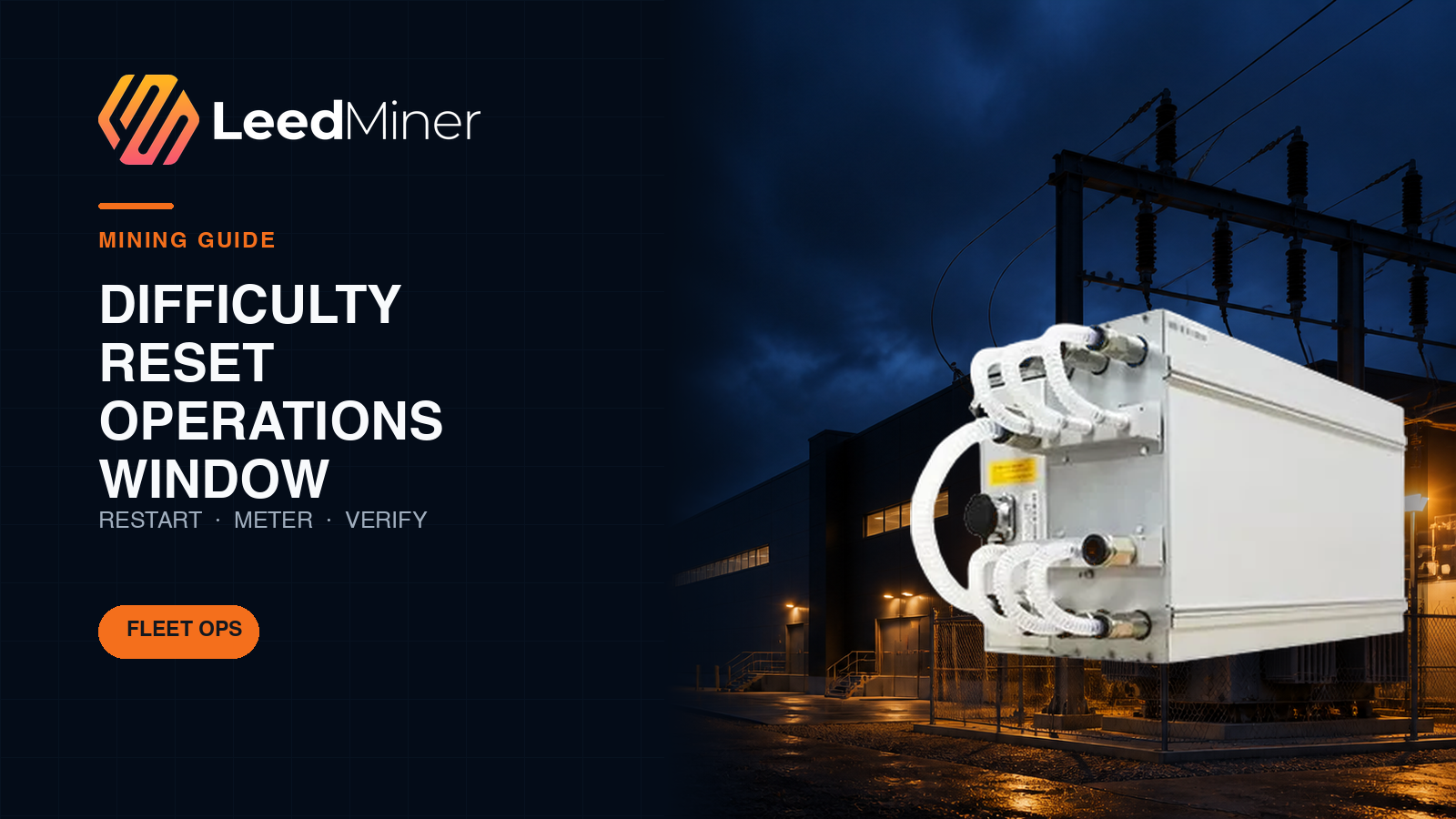
Finally, run a staged outage and restart. Verify that the utility block, cooling loop, control system, network and pool connection return in the intended order without a synchronized inrush or thermal excursion. Document spare pumps, sensors, seals, quick connectors and coolant-testing supplies. If the operator prefers managed infrastructure, compare the service scope through LeedMiner hosting and require evidence for monitoring, preventive maintenance, incident response and restart authority.
A complete handoff package should include the approved single-line diagram, hydraulic schematic, equipment schedule, firmware baseline, serial inventory, valve map, alarm list, sensor calibration, acceptance readings, maintenance intervals and emergency contacts. Keep these records aligned with the exact deployed models; a future hardware substitution can change power, flow or temperature requirements even when the rack footprint looks similar.