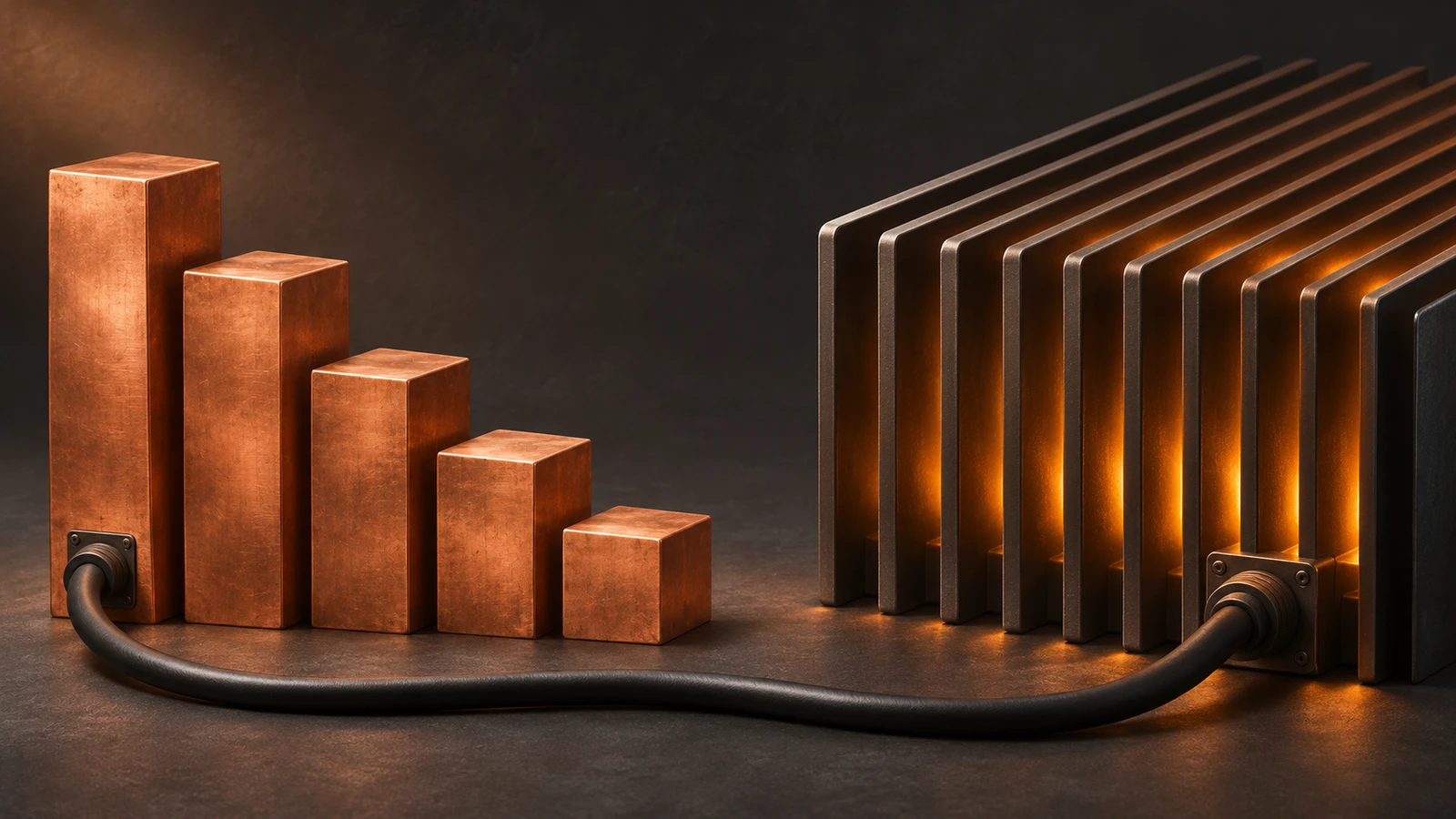




An 18.1% increase in modeled Bitcoin mining revenue can produce a much larger increase in net income because electricity cost does not rise with BTC. With Bitcoin near $74,404, an Antminer S21 XP operating at $0.08/kWh moves from about $1.43 to $2.96 per day after machine electricity in our constant-difficulty scenario—a 106% increase. That is Bitcoin mining operating leverage in practical terms.
This article explains why margin can double, where that conclusion holds, and where it breaks. It is an operating model, not a promise of future income. Pool fees, hosting, cooling overhead, maintenance, downtime, taxes, financing, and changes in difficulty must still be deducted.
Key takeaways
- BTC rose 18.1% from the $63,019 comparison baseline to the $74,404 snapshot used here.
- If BTC-denominated block revenue and difficulty stay constant, modeled hashprice rises from $31.23 to $36.87 per PH/s/day.
- At $0.08/kWh, modeled income after machine power rises 106% for an S21 XP, 43% for an S23 Hyd, and 78% for a WhatsMiner M73S+.
- The percentage jump is largest near break-even, but those narrow-margin machines are also most exposed to difficulty, downtime, fees, and tariff changes.
What operating leverage means for Bitcoin miners
Operating leverage appears when revenue changes while a large part of cost stays fixed or moves slowly. For a running ASIC over a short interval, hashrate and power draw are relatively stable. If BTC increases and all other mining variables remain constant, dollar revenue rises while the kWh consumed by the machine stays about the same. The remaining margin therefore changes faster than gross revenue.
Use a simple equation: income after machine power = (hashrate in PH/s × hashprice) − (kW × 24 × electricity rate). The first term responds to hashprice; the second term depends on the tariff and machine draw. Our earlier BTC-above-$70K analysis used a $31.23 hashprice at a $63,019 BTC baseline. Scaling only the BTC component to the $74,404 market snapshot gives $36.87 per PH/s/day, an 18.1% increase.
Why an 18% revenue gain can more than double net income
Consider the Antminer S21 XP at 270 TH/s and 3,645 W. At the $31.23 baseline, modeled gross revenue is $8.43 per day. Electricity at $0.08/kWh costs $7.00, leaving $1.43 after machine power. At the $36.87 scenario, gross revenue becomes $9.96 while electricity remains $7.00, leaving $2.96. Gross rose by $1.52, but the residual margin rose by the same dollar amount from a small starting base, producing a 106% percentage increase.
This is the denominator effect. It is powerful, but it does not make a marginal machine low-risk. A small difficulty increase, a few hours of downtime, higher cooling load, or a pool-fee deduction can remove much of a narrow margin. The Bitcoin Developer Guide explains the protocol’s difficulty adjustment; operators should check live hashprice and network conditions rather than assuming the BTC move passes through unchanged.
Machine comparison at $0.08/kWh
The table holds difficulty, block fees, pool performance, and uptime constant. “After power” subtracts only machine electricity and is not full accounting profit. Values are rounded.
| Miner | Efficiency | After power at baseline | After power at $74,404 | Modeled recovery |
|---|---|---|---|---|
| Antminer S21 XP 270 TH/s | 13.5 J/TH | $1.43/day | $2.96/day | +106% |
| Antminer S21 XP Hyd 473 TH/s | 12 J/TH | $3.87/day | $6.54/day | +69% |
| Antminer S23 Hyd 580 TH/s | 9.5 J/TH | $7.53/day | $10.81/day | +43% |
| WhatsMiner M73S+ 570 TH/s | 12.5 J/TH | $4.12/day | $7.34/day | +78% |
The S21 XP has the largest percentage increase because its baseline margin is smallest. The S23 Hyd adds more dollars of after-power income and retains the largest buffer because 9.5 J/TH consumes less energy per unit of hashrate. Percentage recovery and operational resilience are different measures; fleet planning needs both.
Electricity rate changes the leverage curve
For the S21 XP in the $74,404 scenario, after-power income is approximately $4.71/day at $0.06/kWh, $2.96 at $0.08, and $1.21 at $0.10. The machine’s modeled power-only break-even is about $0.114/kWh. For the S23 Hyd, the equivalent break-even is roughly $0.162/kWh because of its 9.5 J/TH efficiency. These ceilings exclude auxiliary power and every non-energy cost.
A lower tariff increases absolute margin but often reduces the percentage leverage from a BTC move, because the starting margin is already larger. A high tariff creates spectacular percentage recovery near break-even, yet leaves little protection. This is why operators should rank machines by dollars per day, margin per MW, and downside break-even—not by percentage gain alone. Test each tariff in the profitability calculator.
Difficulty, uptime, and fees can reverse the result
If network difficulty rises 10% while all other variables stay fixed, revenue per unit of hashrate falls by roughly 9.1%. That would absorb about half of the 18.1% BTC-led recovery modeled here. Pool fees, transaction-fee variability, reject rate, and curtailment create additional differences between a spreadsheet and realized revenue.
Uptime also has leverage. At 95% pool-side uptime, gross revenue falls 5%, but the facility may still carry demand charges, staffing, network, and fixed hosting commitments. Measure uptime at the pool, not only at the machine dashboard, and reconcile it against metered energy. Build a repair reserve so a temporary price improvement does not encourage operation of unreliable hardware.
Use hosting, containers, and curtailment as margin controls
Hosting can convert site-development risk into a contracted operating service, but the decision must use the all-in rate and service terms. Container solutions can accelerate owned deployment where power and land are available. In both cases, confirm auxiliary load, curtailment rights, repair workflow, security, pool access, heat-rejection design, and expansion capacity.
Flexible load is valuable when tariffs or grid conditions change. Define a shutdown hashprice and maximum power rate for every efficiency class. Then automate alerts and use controlled curtailment rather than waiting for daily revenue to turn negative. The operating-leverage upside belongs to the owner only if the fleet remains available when economics improve.
How miners should act at $74K
Recalculate every machine with a current hashprice, actual tariff, pool-side uptime, and full operating cost. Restart the highest dollar-margin machines first. Keep marginal units dispatchable for low-cost hours, and preserve liquidity for difficulty changes and repairs. A higher BTC price improves the opportunity set; it does not remove operational discipline.
Next step: LeedMiner can compare in-stock Bitcoin miners, hosting, and container deployment for your voltage, cooling, tariff, and available MW. Machine images and technical details are shown without publishing equipment sale prices. Request a site-specific mining margin review.