


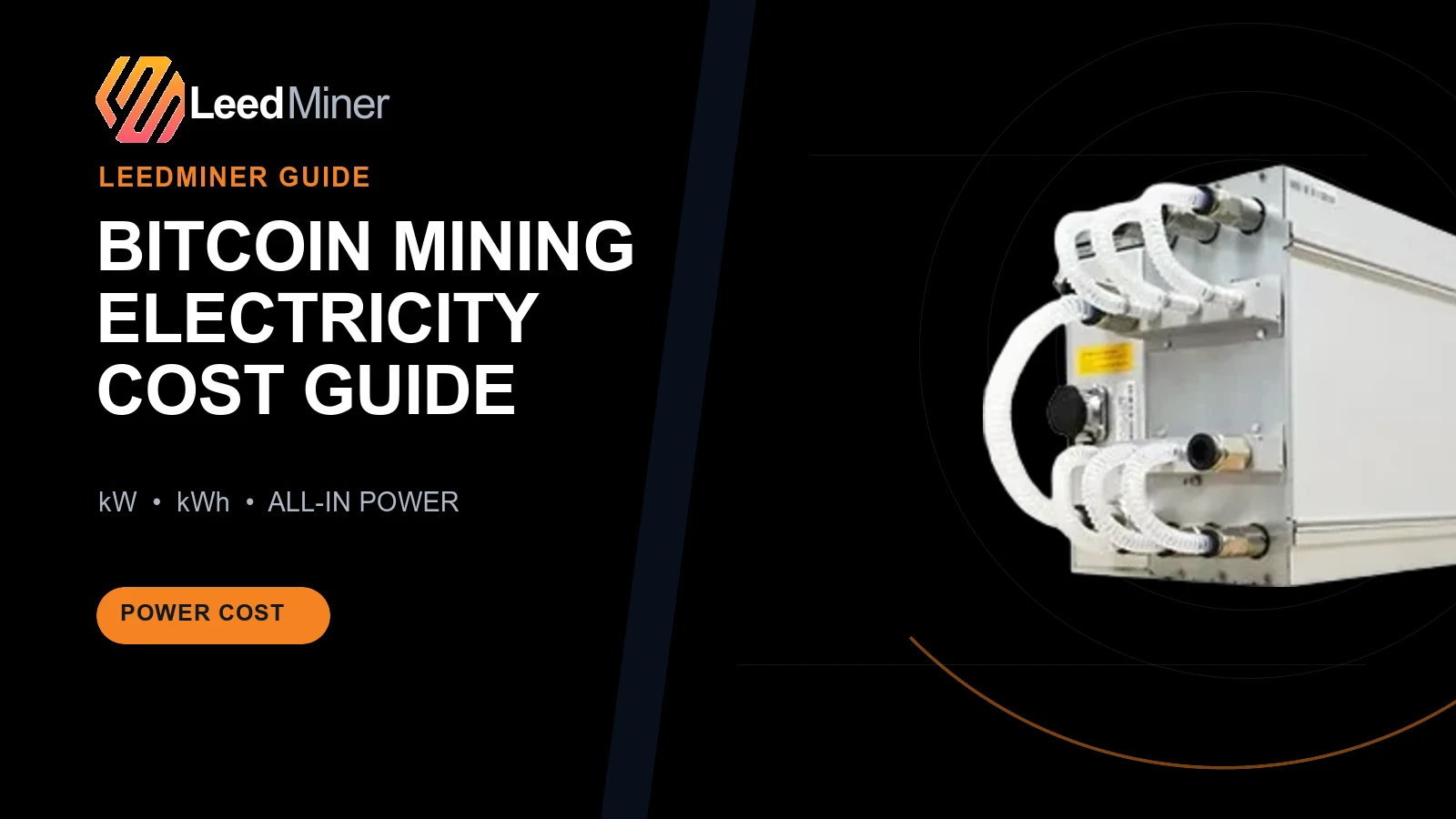
Electricity cost is the operating variable a Bitcoin miner can measure most directly, yet it is often reduced to a single cents-per-kWh number. A reliable 2026 model starts with the miner’s wall power and then adds delivery charges, demand charges, cooling, pumps, fans, transformers, conversion losses and downtime. This guide shows how to turn a power specification into a decision-ready cost range without presenting profitability as guaranteed.
The core electricity formula
For one miner:
power in kW × operating hours = energy in kWh
energy in kWh × all-in electricity price = electricity cost
Convert watts to kilowatts by dividing by 1,000. A 5,510 W miner is 5.51 kW. At continuous operation:
- 5.51 × 24 = 132.24 kWh per day;
- 132.24 × $0.08 = $10.58 per day;
- 132.24 × $0.12 = $15.87 per day;
- over 30 days, those rates produce about $317.38 and $476.06 in miner-only electricity cost.
These are energy costs, not net profit calculations. Revenue changes with Bitcoin price, network difficulty, block subsidy, transaction fees, pool terms and actual hashrate.
Use the delivered rate, not a headline rate
The U.S. Energy Information Administration explains that average retail prices include generation, transmission, distribution, taxes and fees, while an individual utility rate may also vary by customer type and time of use. EIA data are useful context, but your bill and tariff govern the project. See the EIA electricity price explanation and state and sector tables.
Build the model from these bill components:
- energy charge per kWh;
- delivery and transmission charges;
- taxes, riders and fuel adjustments;
- time-of-use or real-time pricing;
- monthly fixed charges;
- peak-demand charge per kW, if applicable;
- penalties or curtailment terms;
- currency conversion for a non-USD bill.
Divide the total variable bill attributable to mining by mining kWh to obtain an effective delivered rate. Keep fixed site costs separate so you can see what changes when one more miner is added.
Verify the exact model and operating mode
Similar product names can hide different hashrates, power draws and cooling systems. BITMAIN’s official S23 Hyd. manual specifies a typical 580 TH/s, 5,510 W at the wall and 9.5 J/TH, with three-phase 380–415 V input and defined coolant requirements. Review the official S23 Hyd. product manual before planning infrastructure.
Do not copy the power number from a neighboring variant. Confirm the nameplate, firmware mode, ambient or coolant temperature and manufacturer tolerance. Measure sustained wall power after commissioning; a nominal figure is a planning input, not a substitute for metering.
Product card — Antminer S23 Hyd (580 TH/s) Published and in stock at LeedMiner when checked on August 7, 2026. Listed price: $13,061.60. Catalog power: 5,510 W; hydro cooling and high-voltage three-phase infrastructure are required. View the Antminer S23 Hyd
Add cooling and balance-of-system power
Air-cooled miners may need exhaust fans, make-up air or air conditioning. Hydro models need pumps, heat exchangers, dry coolers or container systems. Network switches, controllers, lighting and security also consume power.
Measure auxiliary loads at the site boundary when possible. If miner power is 100 kW and cooling plus support systems draw 12 kW, the facility uses 112 kW before other losses. Modeling only the miners understates both cost and electrical capacity.
Cooling load is not constant. It can change with outdoor temperature, coolant set point, airflow restrictions and equipment condition. Use monthly or seasonal scenarios instead of one annual percentage.
Demand charges can change the answer
A commercial customer may pay for the highest measured demand interval in addition to energy. Starting many miners together can establish an expensive peak even if they are later curtailed. Review the tariff’s demand window, ratchet, power-factor rules and coincident-peak provisions.
A staged restart, load controller or curtailment agreement may reduce peaks, but every strategy needs operational verification. Do not assume that turning miners off for a few hours eliminates a demand charge already set earlier in the billing period.
Model uptime honestly
A theoretical 24/7 month contains 720 hours. Actual billable hours may be lower because of maintenance, thermal limits, pool or network outages, utility curtailment and repairs. Lower uptime reduces electricity cost, but it also reduces revenue.
Create at least three scenarios:
- base case: expected measured power and realistic uptime;
- stress case: lower revenue, higher difficulty and higher delivered electricity price;
- operational case: seasonal cooling, curtailment and planned maintenance.
Use the LeedMiner profit calculator for scenario work, then reconcile its miner-level output with your facility bill model.
Compare hardware by watts and infrastructure, not price alone
A lower purchase price can be offset by poorer efficiency or incompatible infrastructure. A high-efficiency hydro unit may still be the wrong purchase if the site lacks the voltage, pumps and heat rejection it requires. Compare exact variants in the ASIC comparison tool.
Product card — WhatsMiner M7D (652 TH/s) Published and in stock when checked. Listed price: $5,607.20. Confirm the current power, voltage, cooling loop and delivery batch on the live quotation before modeling. View the WhatsMiner M7D
Product card — Canaan Avalon A15 Pro (221 TH/s) Published and in stock when checked. Listed price: $2,011.00. Confirm the exact 221 TH/s variant, wall power, operating mode and site voltage before purchase. View the Avalon A15 Pro
Prices and stock can change. If a live product has no price, request an Inquiry quotation rather than treating the commercial field as pending.
Convert cost into an operating threshold
Once daily all-in power cost is known, compare it with daily gross mining revenue from the same date and assumptions. The gap must cover pool fees, hosting labor, repairs, financing, tax, downtime and capital recovery. A positive gap is not automatically profit.
Bitcoin’s developer documentation explains that proof of work secures the chain through cumulative computational work; it does not promise an individual operator a fixed reward. Review the Bitcoin developer guide for the protocol context, and use current network data for every commercial decision.
Track these fields in an operating sheet: date, miner and firmware mode, measured kW, hashrate, pool revenue, uptime, delivered electricity rate, auxiliary kW and reason for downtime. Historical records reveal whether a model is drifting or whether site overhead is increasing.
Final electricity-cost checklist
Before approving a purchase, verify the exact model, measured or manufacturer wall power, voltage, cooling design, delivered tariff, demand charges, seasonal auxiliary load, uptime assumptions and downside revenue case. Then confirm freight, warranty and repair logistics.
Browse published Bitcoin miners, compare exact configurations, and contact LeedMiner with your country, voltage, tariff structure, target capacity and cooling method. LeedMiner can prepare a current equipment quotation while you keep the electricity model tied to the real site.