


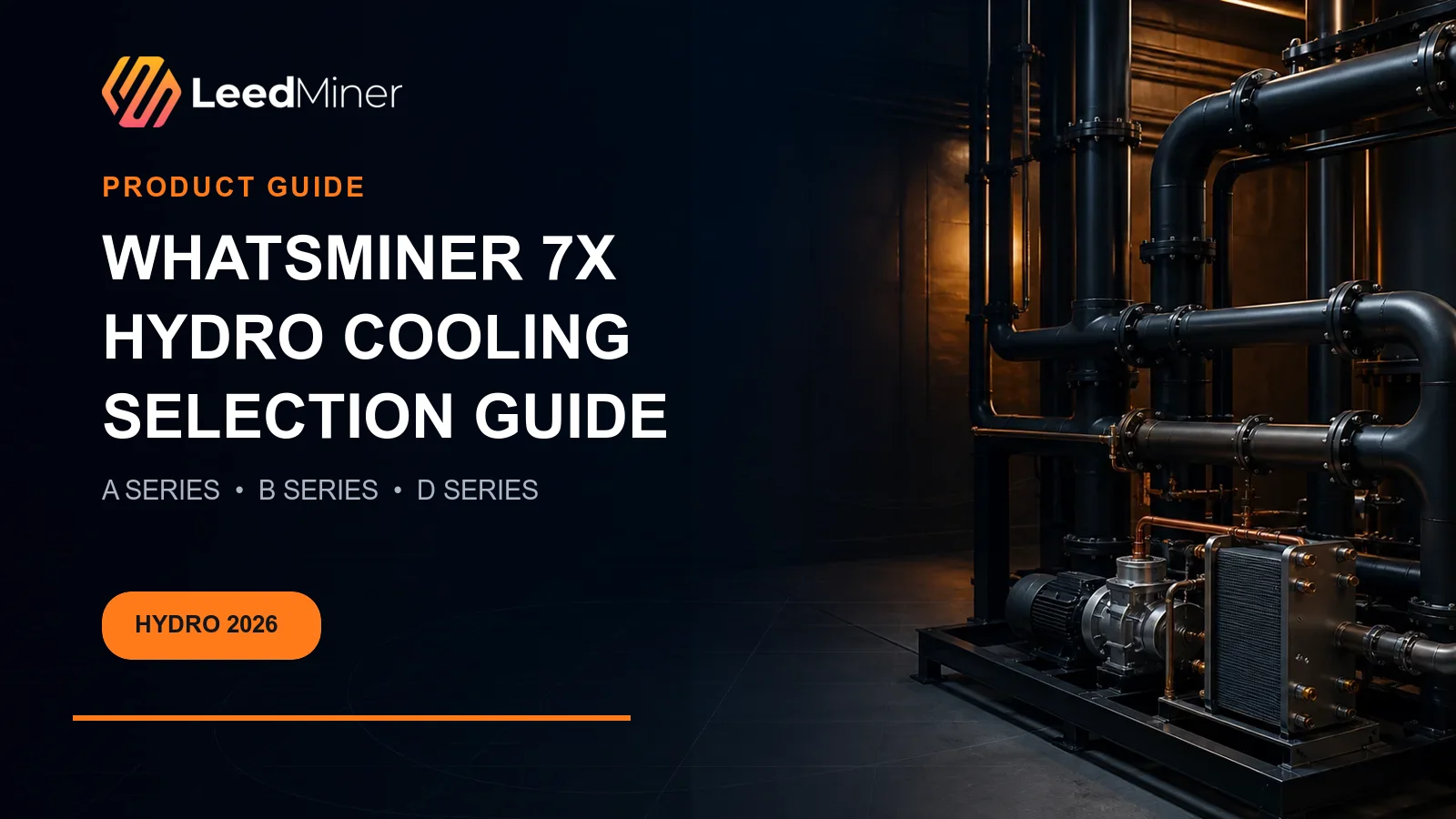
WhatsMiner's 7X hydro-cooling range is not one interchangeable product family. The official July 2026 briefing separates it into A, B, and D series with different outlet-temperature limits, power modes, and deployment goals. Those differences matter before a buyer compares headline hashrate, because the cooling loop, electrical design, heat-reuse target, and operating philosophy must match the selected server.
This guide turns the official parameters into a practical selection framework. It also explains where currently available M6DS+ and M6DS++ units fit as D-series baselines while LeedMiner verifies quotations for newer 7X configurations. Specifications and availability can change, so use this article for planning and request a dated configuration check before ordering.
What WhatsMiner announced for the 7X hydro range
WhatsMiner's official 7X hydro-cooling introduction defines three thermal families:
- A series: outlet liquid up to 70°C, 7,200 W standard mode, and 10 kW high-performance mode with overclocking support.
- B series: outlet liquid up to 90°C, the same 7,200 W standard and 10 kW high-performance modes, plus a higher-temperature operating envelope.
- D series: outlet liquid up to 65°C, fixed 9,200 W operation, and no overclocking.
The official table lists efficiency steps from 17 J/TH through 12.5 J/TH in A and B configurations, while the D family spans 17 J/TH to 13.5 J/TH. These are range specifications, not a promise that every unit will ship at the upper hashrate value or operate at every temperature without the matching infrastructure.

A series: flexible performance with a 70°C outlet ceiling
The A series is the balanced option when an operator wants both a normal 7,200 W profile and a higher-performance mode. WhatsMiner states a coolant demand of about 1.3 liters per unit and says the higher flow supports stable heat removal. The practical question is not merely whether overclocking is available. The electrical distribution, pumps, heat exchangers, dry coolers, controls, and warranty conditions must all support the 10 kW mode.
A-series planning should therefore begin with two site models: the normal-mode fleet load and the maximum approved high-performance load. Cable sizing, protection devices, transformer headroom, coolant flow, and emergency response should be checked against the higher case even if normal mode is expected most of the year.
B series: high-grade heat reuse changes the project
The B series raises the maximum outlet temperature to 90°C. That can make recovered heat more useful for industrial processes, district-heating interfaces, agriculture, or other thermal loads that need hotter water. It also makes inlet control and material compatibility more important. WhatsMiner specifies 25–60°C inlet temperature in normal mode, 25–50°C in high-performance mode, ±2°C inlet control accuracy, and a maximum liquid temperature difference of 40°C.
A 90°C outlet target is not a reason to run every installation at its limit. Engineers should define the receiving heat load, heat-exchanger approach temperature, water chemistry, pressure, seals, pipe ratings, expansion capacity, and seasonal rejection plan. If there is no reliable buyer or use for high-grade heat, the added thermal capability may not create economic value.
D series: fixed power for standardized deployment
The D series takes a different approach: fixed 9,200 W power, no overclocking, inlet liquid up to 50°C, and outlet liquid up to 65°C. WhatsMiner's separate D-series overview emphasizes stable long-term operation and standardized container deployment. For operators who prefer repeatable racks, predictable electrical blocks, and fewer tuning states, that simplicity can be valuable.
The same official overview pairs D-series servers with the HeatCore XS2400 container: 240 server positions, up to 2.4 MW of IT load, closed-loop hydro cooling with a dry cooler, and an annual maximum PUE below 1.05 under the stated design assumptions. Treat those figures as specifications for the complete referenced solution, not as automatic results for a custom container.

Two in-stock hydro options to price now
LeedMiner checked the following published listings on August 14, 2026. They are not substitutes for an exact 7X configuration; they are current D-series options that help buyers price a fixed-power hydro deployment while confirming newer-series lead times.
Infrastructure checklist before selecting A, B, or D
Hydro servers are part of a system. WhatsMiner's official pre-operation checklist says circulation must be established, pipe air removed, leaks checked, cooling plates filled, temperature-control components prepared, and condensation excluded before startup. Build those requirements into commissioning rather than treating them as operator notes.
- Confirm utility capacity for normal, high-performance, and restart conditions.
- Match coolant flow, pressure drop, connector type, and metallurgy across the loop.
- Model the hottest ambient condition and the loss of the intended heat user.
- Provide leak detection, automatic make-up, air removal, isolation, and emergency shutdown.
- Record inlet and outlet temperature, flow, pressure, power, hashrate, alarms, and water quality.
- Verify firmware, overclocking permission, and warranty conditions for the selected mode.
Translate every fleet option into comparable engineering units. At 240 servers, a 9,200 W D-series block represents about 2.208 MW of server load before pumps, controls, networking, and heat rejection. An A- or B-series fleet at 7,200 W starts lower, but the same 240 positions would reach 2.4 MW in 10 kW high-performance mode. That gap affects transformer reserve, feeder sizing, curtailment steps, and the generator or UPS strategy for controls. It also shows why a lower nominal mode should not be used to approve infrastructure that may later run a higher authorized profile.
Compare efficiency on the same basis as well. Multiply hashrate by J/TH to estimate server power, then reconcile the result with the manufacturer's rated mode and tolerance. For recovered heat, begin with measured electrical input and subtract only losses that actually leave the useful thermal boundary.
How to choose the right family
Choose A when flexible performance is valuable and the site can support the 10 kW high-performance case. Choose B when there is a credible high-temperature heat user and the thermal loop is engineered for the 90°C outlet envelope. Choose D when fixed power, standardized blocks, and operational simplicity matter more than tuning flexibility.
Then compare the equipment with LeedMiner's published miner inventory, check economics with the profit calculator, and review fleet options in the comparison tool. For a dated 7X availability check, coolant and electrical review, or a quotation for an in-stock D-series unit, contact LeedMiner with your voltage, available megawatts, ambient range, target inlet and outlet temperatures, and heat-reuse plan.