


SUMMARY
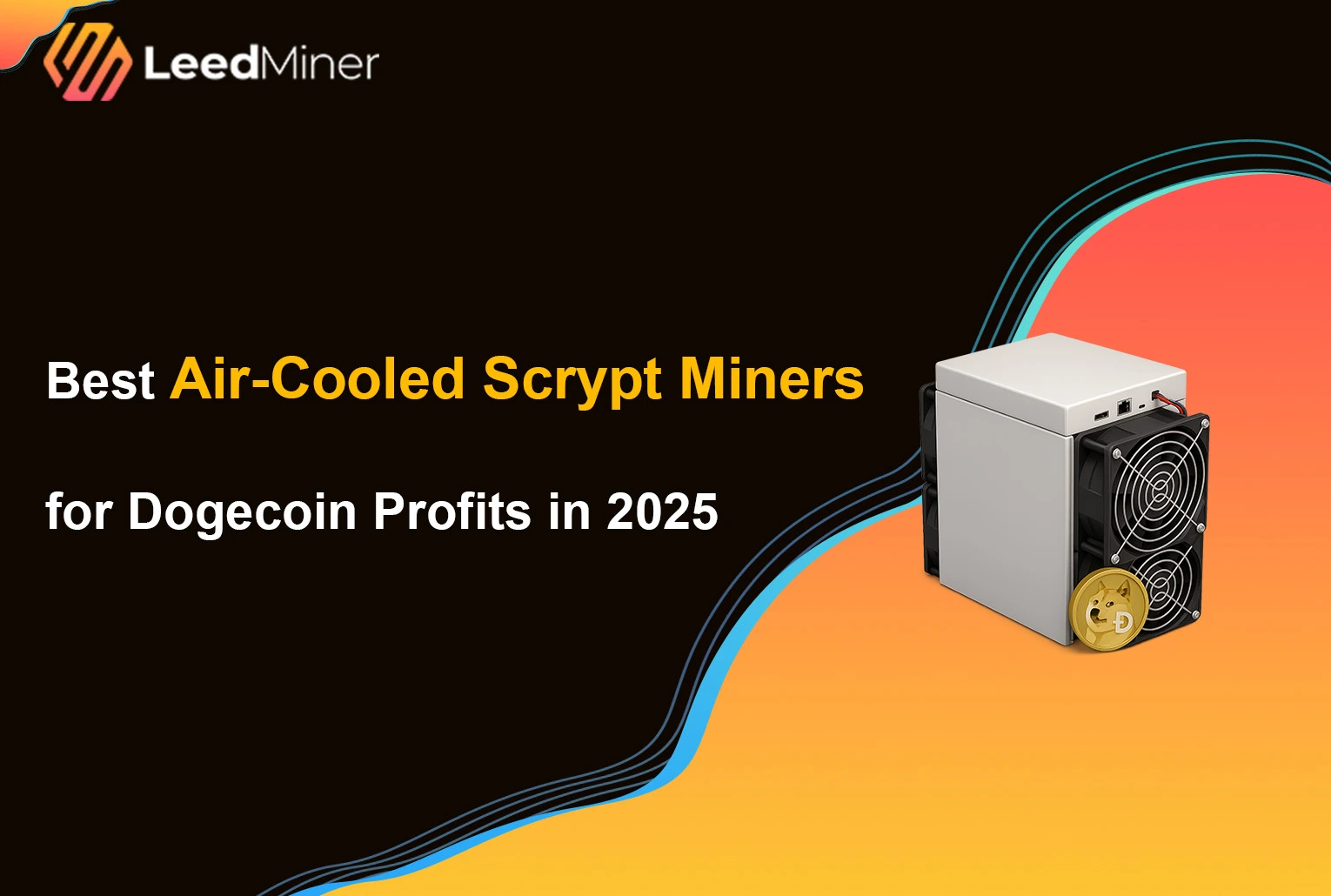
As Dogecoin continues to perform strongly in 2025, more miners are seeking efficient and reliable Scrypt-based mining hardware. This article focuses on the best-performing Scrypt miners on the market, helping you maximize profits from DOGE and LTC merged mining. All profitability estimates are based on a standard electricity rate of $0.07/kWh, with clear ROI and payback period calculations based on daily income, power costs, and device pricing.
Introduction
Following the crypto market’s recovery in 2024, Dogecoin (DOGE) — a leading Scrypt algorithm coin — is once again drawing attention from miners and investors alike. Thanks to merged mining with Litecoin (LTC), DOGE mining is more profitable than ever, allowing miners to earn two coins simultaneously with no extra cost. Although liquid-cooled (water-cooled) miners are gaining traction in high-density farms, air-cooled devices remain the top choice for small to medium-scale operations due to their low initial investment, easier deployment, and lower maintenance needs. In this article, we review the best air-cooled Scrypt miners of 2025, covering performance specs, efficiency, noise levels, and real-world profitability—so you can make informed investment decisions.
Why Air-Cooled Miners Still Make Sense in 2025

While water-cooled miners are on the rise, air-cooled machines continue to offer compelling advantages in 2025:
- Lower upfront costs: Air-cooled miners don’t require water blocks, pumps, or cooling towers, making them ideal for home users or first-time investors.
- Flexible deployment: No need for plumbing or liquid loops—air-cooled units can be set up quickly in garages, offices, or modular containers.
- Lower maintenance: No need to replace coolant or deal with leak risks. Just keep the fans clean and airflow unobstructed.
- Mature design: Modern air-cooled miners feature improved fan control, smarter temperature management, and better noise suppression.
For miners who prioritize simplicity, affordability, and scalability, air-cooled Scrypt machines remain a smart and competitive option.
Bitmain Antminer L9 (16 GH/s): The Industry Standard
The Bitmain Antminer L9 has become the benchmark for Scrypt algorithm mining in 2025. Released in May 2024, it represents Bitmain’s most advanced offering for miners seeking high-performance Dogecoin and Litecoin yields in an air-cooled format.
Performance and Technical Overview
With a hashrate of 16 GH/s and power consumption of 3360W, the L9 is engineered for industrial-grade efficiency. Its twin-fan air cooling system maintains thermal stability, while its dimensions (195mm x 290mm x 379mm) make deployment compact. The 75dB noise level requires a dedicated, ventilated mining space.
Power Efficiency and Deployment
Requiring 220–277V input, the L9 is unsuitable for household plugs and demands stable single-phase industrial power. Its energy efficiency and consistent hashrate make it ideal for serious Scrypt mining farms.
Noise Level and Cooling Requirements
Running at 75dB, the L9 is loud enough to demand isolated setups. Proper airflow and ambient control between 5°C and 45°C are essential for longevity and reliability.
ROI and Payback Period
- Daily Income: $16.98
- Daily Electricity Cost: -$5.64
- Daily Net Profit: $11.33
- Purchase Price: $7,350
- Estimated Payback: 7,350 ÷ 11.33 ≈ 649 days
ElphaPex DG 1+: Performance-Oriented Competitor

Released in April 2024, the DG 1+ is ElphaPex’s flagship air-cooled Scrypt miner targeting the high-efficiency mid-range market. It is designed for miners seeking slightly lower capital investment with strong returns.
Performance and Technical Overview
Delivering 14 GH/s at 3920W, this model includes four cooling fans and operates with a 75dB noise output. It runs best in industrial environments with high airflow and dedicated power lines (200–240V).
Power Efficiency and Deployment
Though slightly less efficient than the Antminer L9, its lower price point gives it a competitive ROI. It offers solid long-term profitability with manageable noise and cooling needs.
Noise Level and Cooling Requirements
Like most industrial air-cooled models, the DG 1+ must run in a purpose-built mining room or warehouse setup. It cannot be used in a residential environment due to 75dB noise.
ROI and Payback Period
- Daily Income: $16.47
- Daily Electricity Cost: -$6.59
- Daily Net Profit: $9.88
- Purchase Price: $5,700
- Estimated Payback: 5,700 ÷ 9.88 ≈ 577 days
ElphaPex DG 2: 2025’s Mining Powerhouse

Released in June 2025, the DG 2 sets a new standard in power and profitability for Scrypt miners. With a whopping 20 GH/s output, it’s built for maximum returns.
Performance and Technical Overview
The DG 2 produces 20 GH/s at 3800W, making it the most powerful air-cooled unit on this list. Despite its large size and weight (16.5kg), it uses only 3800W, maintaining a good power-to-performance ratio.
Power Efficiency and Deployment
It operates between 200-240V, meaning professional deployment is necessary. It’s the go-to miner for those with sufficient infrastructure who want top-tier Dogecoin mining returns.
Noise Level and Cooling Requirements
Its 75dB output and 4-fan setup demand industrial environments. It performs best with controlled ambient temperatures and active exhaust systems.
ROI and Payback Period
- Daily Income: $23.53
- Daily Electricity Cost: -$6.38
- Daily Net Profit: $17.14
- Purchase Price: $9,499
- Estimated Payback: 9,499 ÷ 17.14 ≈ 554 days
ElphaPex DG Home 1: Quiet and Residential Friendly

Targeted at home users, the DG Home 1 is the only miner on this list with a 50dB noise level and liquid cooling. It was released in October 2024 as a quieter alternative for hobbyists.
Performance and Technical Overview
With 2.2 GH/s and 620W power consumption, it’s designed for low-noise, low-heat environments. Ideal for home garages or hobby mining rooms.
Power Efficiency and Deployment
It can run on a standard household power supply, making it more accessible than higher-powered rigs. However, its earnings potential is much lower.
Noise Level and Cooling Requirements
Thanks to liquid cooling and a low noise profile, the DG Home 1 can operate in a home office or enclosed cabinet with basic ventilation.
ROI and Payback Period
- Daily Income: $2.13
- Daily Electricity Cost: -$1.04
- Daily Net Profit: $1.08
- Purchase Price: $1,199
- Estimated Payback: 1,199 ÷ 1.08 ≈ 1,110 days
Bitmain Antminer L7: Legacy Unit Still Mining

Though released in late 2021, the Antminer L7 remains in use today. It delivers solid performance but is now behind in power efficiency compared to newer models.
Performance and Technical Overview
The L7 provides 9.5 GH/s with 3425W power usage. It’s well-built with proven long-term reliability but lacks the optimization seen in 2024–2025 hardware.
Power Efficiency and Deployment
It still serves ROI-focused miners seeking used hardware at discounted prices. It requires industrial power and dedicated ventilation.
Noise Level and Cooling Requirements
Running at 75dB, it remains loud and unsuitable for non-industrial setups.
ROI and Payback Period
- Daily Income: $10.10
- Daily Electricity Cost: -$5.75
- Daily Net Profit: $4.34
- Purchase Price: $8,500
- Estimated Payback: 8,500 ÷ 4.34 ≈ 1,959 days
Profitability Comparison: Which Miner Makes the Most DOGE
To help you compare across models, we’ve standardized key assumptions:
- Electricity rate: $0.07 / kWh
- DOGE & LTC prices: Held within current volatility range
- All hardware is assumed to run stably, with no maintenance costs
| Miner Model | Hashrate | Power Draw | Daily Profit | Price | ROI (Days) | ROI (Months) |
|---|---|---|---|---|---|---|
| ElphaPex DG 2 | 20 GH/s | 3800W | $17.14 | $9,499 | 554 | 18.4 mo |
| Bitmain Antminer L9 | 16 GH/s | 3360W | $11.33 | $7,350 | 649 | 21.6 mo |
| ElphaPex DG 1+ | 14 GH/s | 3920W | $9.88 | $5,700 | 577 | 19.2 mo |
| Antminer L7 | 9.5 GH/s | 3425W | $4.34 | $8,500 | 1,959 | 65.3 mo |
| ElphaPex DG Home 1 | 2.2 GH/s | 620W | $1.08 | $1,199 | 1,110 | 37 mo |
Note: These ROI estimates are based on current market conditions and do not account for future fluctuations in mining difficulty, DOGE/LTC prices, or hardware prices. All values should be considered approximate and subject to change based on real-time market data.
CONCLUSION
Based on hashpower, energy efficiency, and ROI, here are the top recommendations for different mining profiles:
- For professional-scale miners: Go with the ElphaPex DG 2 or Antminer L9 for maximum power and profitability.
- For mid-size farms: The DG 1+ offers high returns at a more affordable price point.
- For beginners or home setups: The DG Home 1 offers quiet operation, compact size, and low power consumption, though with a longer payback period.
As DOGE+LTC merged mining remains lucrative, air-cooled miners are still a wise investment for 2025. Especially if coin prices surge or older hardware exits the network, owning a cost-effective air-cooled rig with solid long-term potential can give you a meaningful edge.