
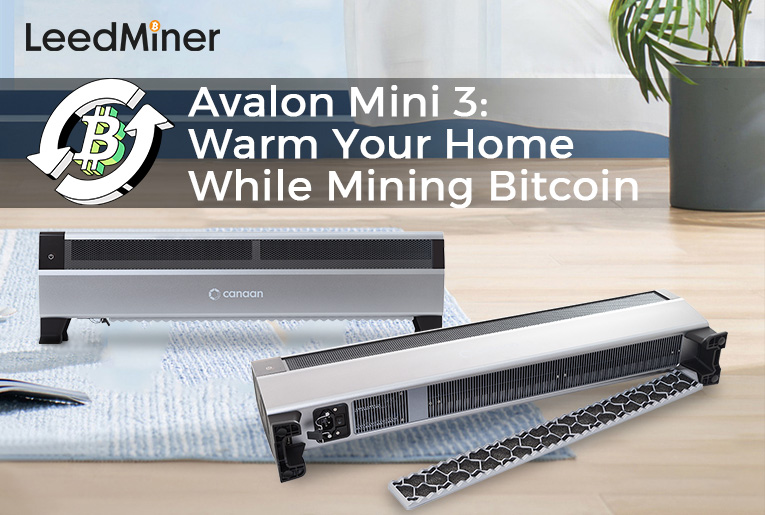
The Canaan Avalon Mini 3 is unusual because it is designed as a household heater first and a Bitcoin miner second. Instead of pushing hot exhaust out of a mining room, it puts the heat where a home may already need it. That can make the electricity easier to justify during cold weather, but it does not make the energy free or guarantee mining profit.
This 2026 buyer guide explains the operating modes, realistic electricity math, room placement and setup workflow. The current LeedMiner listing checked on August 11, 2026 shows 37.5 TH/s, 800 W maximum catalog power, a 110–240 V input range, 35 dB catalog noise and an in-stock price of $819. Confirm the exact batch, plug, warranty and destination requirements before ordering.
What the Avalon Mini 3 actually does
Canaan describes the Mini 3 as a household baseboard heater that mines Bitcoin. Its computing chips consume electricity to perform SHA-256 work, and nearly all of that electrical input eventually becomes heat in the room. The device therefore combines two outputs: useful space heat and mining hashrate submitted to a pool.
That combination is most valuable when the heat is genuinely wanted. In winter, the correct comparison may be Mini 3 electricity minus the electricity that another resistance heater would have consumed, then adding whatever mining rewards are actually received. In warm weather, the heat becomes a load that must be removed or tolerated, so the economics are less attractive.
Do not describe this as “free heat.” You still buy every kilowatt-hour. Mining rewards may offset part of that heating cost, but pool performance, Bitcoin price, network difficulty, transaction fees and downtime change. Use the LeedMiner profit calculator with current inputs rather than relying on a dated daily-profit screenshot.
Official operating modes explained
Canaan’s official Mini 3 mode guide identifies Heater, Mining and Night modes. Heater Mode has two power settings and can use a target room temperature set through the Avalon Family App.
- Heater Eco: optimized for 500 W output. This is the lower-power choice for mild heating or a smaller room.
- Heater Super: operates at 800 W for maximum heating and mining performance.
- Mining Mode: prioritizes mining. Canaan says fan noise can be higher because the device manages a lower chip-temperature target and runs at full capacity.
- Night Mode: prioritizes quieter heating and adjusts fan speed while allowing a target temperature.
In Heater Mode, the unit can enter idle when the room reaches the selected temperature and resume when the temperature falls 2°C below the target. Canaan also states a maximum allowed ambient temperature of 40°C for this mode; the device idles at that threshold and resumes below 38°C. These controls help manage comfort, but they do not replace sensible placement or supervision.
Electricity and heat: use durable math
At a continuous 500 W, the Mini 3 uses 0.5 kWh each hour, or 12 kWh over 24 hours. At 800 W, it uses 0.8 kWh per hour, or 19.2 kWh over 24 hours.
| Setting | Energy per 24 hours | At $0.08/kWh | At $0.12/kWh | At $0.20/kWh |
|---|---|---|---|---|
| 500 W | 12.0 kWh | $0.96 | $1.44 | $2.40 |
| 800 W | 19.2 kWh | $1.54 | $2.30 | $3.84 |
These are electricity costs, not profit estimates. A thermostat-controlled heater may idle for part of the day, while Mining Mode may run more continuously. Measure actual wall consumption and runtime after installation. For a mining forecast, also subtract pool fees, rejected shares, downtime, taxes and the delivered hardware cost.
An 800 W device produces about the same room heat as an 800 W electric resistance heater while operating. It is suitable for supplemental zone heating, not for assuming that one unit can replace a building’s engineered heating system. Room size, insulation, outside temperature, air movement and desired temperature all affect the result.
Where the Mini 3 fits best
The strongest use case is a dry, ventilated room that needs steady supplemental heat: a home office, workshop, studio or cool bedroom where the catalog sound level is acceptable. The long baseboard-style body should have clear air paths and enough space for service.
Avoid locations where heat is already a problem. A summer room with air conditioning forces one system to remove heat that the miner just created. Also avoid damp areas, blocked intakes, deep-pile surfaces and positions where curtains, bedding, paper or furniture can restrict airflow. Follow the current product manual and local electrical rules for clearances.
The catalog lists 110–240 V compatibility, but voltage alone is not enough. Confirm the supplied plug, frequency, circuit rating and continuous-load allowance for the destination. Use a grounded outlet and have a qualified electrician assess any uncertain circuit. Do not operate a continuous 800 W load through a damaged adapter, loose receptacle or improvised extension arrangement.
Setup workflow for a first-time owner
- Inspect before power-on. Verify the product label, housing, cord, plug and package contents. Stop if shipping damage or loose parts are visible.
- Choose the operating position. Place the unit on a stable surface with the manufacturer’s clearances, open intake and exhaust paths, and protection from water, children and pets.
- Confirm the circuit. Match the exact plug and voltage to a grounded circuit with adequate continuous capacity. Avoid sharing the circuit with other large heaters or appliances.
- Connect the local network. Follow the current quick-start guide and Avalon Family App instructions. Canaan says Home-series controls are designed around the local network rather than a public cloud command channel.
- Configure a mining pool. Enter the pool URL, worker name and password exactly. Use a reputable pool that supports your location and payout preferences, and keep a backup pool ready.
- Start conservatively. Begin in a lower-power or temperature-controlled mode, then observe room temperature, noise, wall power, chip temperature and pool-side accepted hashrate.
- Verify shares, not only the display. The pool dashboard should show accepted work after its normal averaging window. Investigate repeated rejects, disconnects or a sustained gap between local and pool-side hashrate.
- Set a monitoring routine. Check dust, airflow, cable temperature, app alerts, pool status and room comfort. Keep firmware and support files from official Canaan channels.
Canaan’s official setup guidance directs owners to the model quick-start guide for network, pool, miner and account configuration. Its monitoring guidance recommends checking temperature and real-time hashrate in the management interface.
Product card: Canaan Avalon Mini 3
Canaan Avalon Mini 3 — 37.5 TH/s Listed at $819.00, in stock, with 800 W maximum catalog power, 110–240 V input and 35 dB catalog noise. Confirm batch specifications, plug, shipping, warranty and local compatibility in the dated quotation. View the Avalon Mini 3
If a future live listing has no price, treat it as Inquiry and request a current quotation. Never substitute an old price for a blank catalog field.
Safety and maintenance checklist
The Mini 3 contains hot electronics and moving fans. Keep vents open and never cover the unit to increase temperature. Do not place liquids on it. Use smoke and electrical protection appropriate to the room, and follow local rules for unattended heating devices.
Canaan’s general environmental guidance calls for a dry, cool and well-ventilated location. The Mini 3 mode document provides model-specific thermal behavior, so use the model manual when general and model-specific guidance differ. Clean dust only with the unit powered down and according to official instructions; unauthorized disassembly can create electrical, thermal and warranty risks.
Before sleeping near the device, test Night Mode while awake and confirm stable room temperature, acceptable sound and unobstructed airflow. A target temperature is a comfort control, not permission to ignore placement and household fire precautions.
Is the Avalon Mini 3 worth buying in 2026?
The Mini 3 is compelling when you already pay for electric resistance heat and want a quiet, compact way to redirect that energy into both warmth and SHA-256 work. It is less compelling when electricity is expensive, the room does not need heat or the household expects a guaranteed Bitcoin return.
Evaluate it in two layers. First, decide whether an 800 W supplemental heater suits the room, circuit and routine. Second, model the 37.5 TH/s mining output with current difficulty, pool fees and uptime. If both layers make sense independently, the combined device has a credible role.
Compare the exact listing in LeedMiner Compare, browse other home and SHA-256 miners, and contact LeedMiner with your country, voltage, electricity rate and heating use case. Ask for a dated quotation that confirms the unit, plug, warranty and delivered cost before payment.