


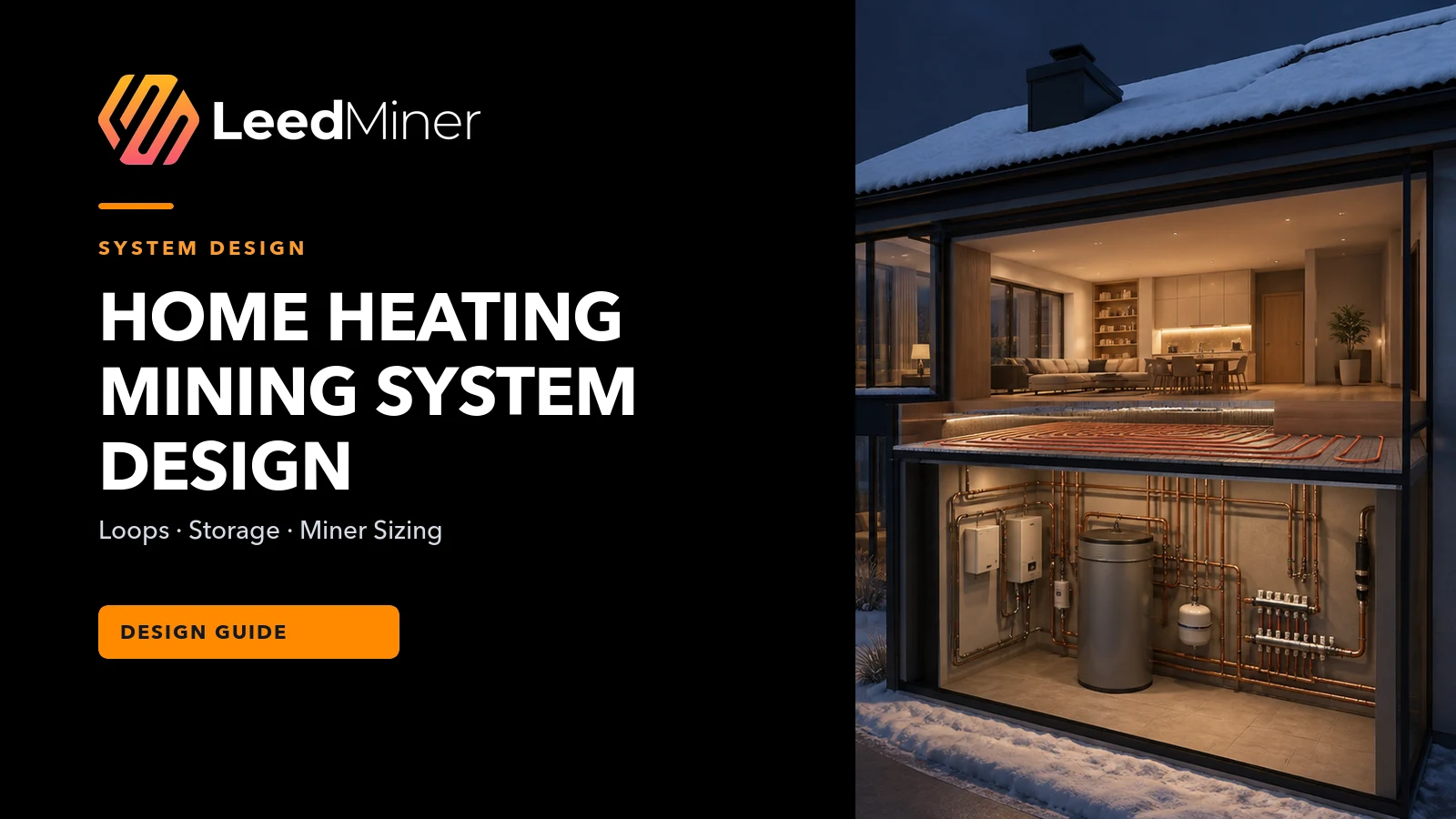
A home heating mining system is not simply a hydro miner connected to a radiator. It is a small energy plant with an electrical load, a primary coolant loop, a heat exchanger, thermal storage, building emitters, controls and an emergency heat-rejection path. Designing those parts as one system is what turns steady ASIC heat into dependable space heating without pushing the miner or the home hydronic loop outside its safe operating range.
This engineering guide focuses on the sequence of decisions: calculate the heat load, select a thermal operating window, size the miner and exchanger, choose storage, design controls, and validate year-round operation. Readers new to the concept should first review Bitcoin Mining Heat Reuse. Packaged examples are listed in LeedMiner's Home Heating Mining category.
1. Calculate design heat loss and the annual load profile
Begin with the building, not the miner. A room-by-room heat-loss calculation establishes the output needed at the local winter design temperature. It should account for walls, roof, floor, windows, doors, infiltration and ventilation. The result is a peak value in kilowatts, but peak load alone is not enough. Create a seasonal profile showing how often the building needs 25%, 50%, 75% and 100% of that output.
This load-duration view prevents oversizing. A mining system selected only for the coldest few hours of the year may produce excessive heat through most of the season. A smaller base-load system can cover the stable portion of demand while an existing boiler or heat pump handles peaks. That hybrid arrangement usually gives better heat utilization and simpler summer operation.
Identify every useful heat sink: radiant floors, fan coils, domestic hot-water preheat, a pool, greenhouse or workshop. Record its supply temperature, return temperature, maximum capacity and schedule. Low-temperature emitters generally make heat recovery easier because they accept useful energy without a large temperature lift.
2. Select miner capacity from thermal output, not hashrate alone
The miner's electrical draw provides the first estimate of thermal output. A 9.2 kW hydro miner represents roughly a 9.2 kW continuous source before distribution losses. Hashrate affects mining economics, but electrical input and permitted coolant temperatures define the heating system. The selected operating mode must fit both the building heat demand and the electrical service.
Check phase, voltage, breaker capacity, conductor sizing, grounding and continuous-load rules. Hydro miners are often designed for three-phase industrial voltage, so a residential project may require service upgrades or a packaged electrical cabinet. The electrical design should include isolation, surge protection, metering and a hardwired emergency stop.
Do not assume that throttling solves every mismatch. Confirm which power modes the manufacturer supports and how reduced power changes flow and outlet temperature. Size pumps and the exchanger for the highest approved mode, then use control logic to modulate within the permitted range.
3. Separate the miner loop from the building loop
A plate heat exchanger is the boundary between the equipment and the property. The primary side follows miner requirements for water quality, corrosion protection, pressure and flow. The secondary side follows local hydronic practice. This separation reduces contamination risk and allows each circuit to have its own expansion vessel, pump and safety devices.
Heat-exchanger selection depends on duty, inlet and outlet temperatures, allowable pressure drop and the temperature approach between circuits. A nominal kilowatt rating without these conditions is not enough. Ask the supplier to calculate the exchanger at the actual design points. Allow margin for fouling and for warmer return water during shoulder seasons.
Use temperature sensors on all four exchanger connections and flow sensors on both circuits. These measurements allow the controller to estimate recovered heat and detect loss of flow, air locking or a dirty strainer. The data also separates actual thermal performance from theoretical miner power.
4. Size buffer storage for control stability
Thermal storage gives the system time to react. The U.S. Department of Energy explains that thermal storage can shift heat across time and help balance supply and demand. In a residential mining loop, a water buffer tank is normally used for short-term smoothing: it reduces rapid cycling, absorbs changes in room demand and provides time to throttle or divert the miner.
Tank size should be calculated from usable temperature range, desired ride-through time and net surplus output. A larger tank is not automatically better; it occupies space, increases standing loss and may slow warm-up. The goal is enough thermal capacity for stable control, not maximum volume.
Place sensors at multiple tank heights when stratification is useful. Control the miner from the upper or average tank temperature, while building pumps respond to zone demand. When the tank reaches its high limit, the system should reduce mining power or enable a secondary heat sink. A dry cooler provides the final year-round rejection path.
5. Build fail-safe controls before optimization
Safety logic takes priority over mining uptime. Minimum controls include low-flow shutdown, high miner-inlet temperature, high outlet temperature, tank high limit, leak detection, pump proof, freeze protection and loss-of-communications behavior. A failure should move the system to a known safe state rather than leave the miner running without heat removal.
After the safety layer is validated, add optimization. Outdoor-reset control can lower building supply temperature in mild weather. Variable-speed pumps can maintain target temperature difference. A schedule can favor mining when heat demand or renewable supply is high, but only after current profitability, tariff structure and hardware limits are considered.
Maintain an independent backup heater. Space heating is a life-safety function in cold climates, while mining depends on network, hardware and market conditions. The building must remain protected during maintenance or a mining shutdown.
6. Validate the package and commission with measured data
This equipment example shows why package naming should state both the container and the exact miner configuration. A system such as the HS20 package must be checked against total connected miner power, the building heat load, electrical intake, water flow and available heat rejection. LeedMiner's HS20 Home Heating Mining System provides a package reference, while the final quote and engineering review should reflect site conditions.
Commissioning should record electrical input, primary and secondary flow, four exchanger temperatures, tank temperatures and delivered building heat. Test loss of flow, high temperature, sensor failure, power outage and recovery. Then compare measured heat utilization with the financial model. Use the profitability calculator for mining inputs and keep avoided heating cost as a separate line.
Design handoff checklist
- Building heat-loss calculation and hourly or seasonal load profile
- Electrical one-line diagram and available service capacity
- Miner operating modes and coolant requirements
- Heat-exchanger schedule with temperatures, flow and pressure drop
- Buffer-tank volume and control set points
- Building emitters and domestic-water separation
- Backup heat and emergency rejection capacity
- Control sequence, alarms and safe shutdown states
- Commissioning test plan and energy-metering points
Once the physical system is defined, the next step is to coordinate it with renewable supply, thermal storage and flexible operation. See From Waste Heat to Circular Energy.