


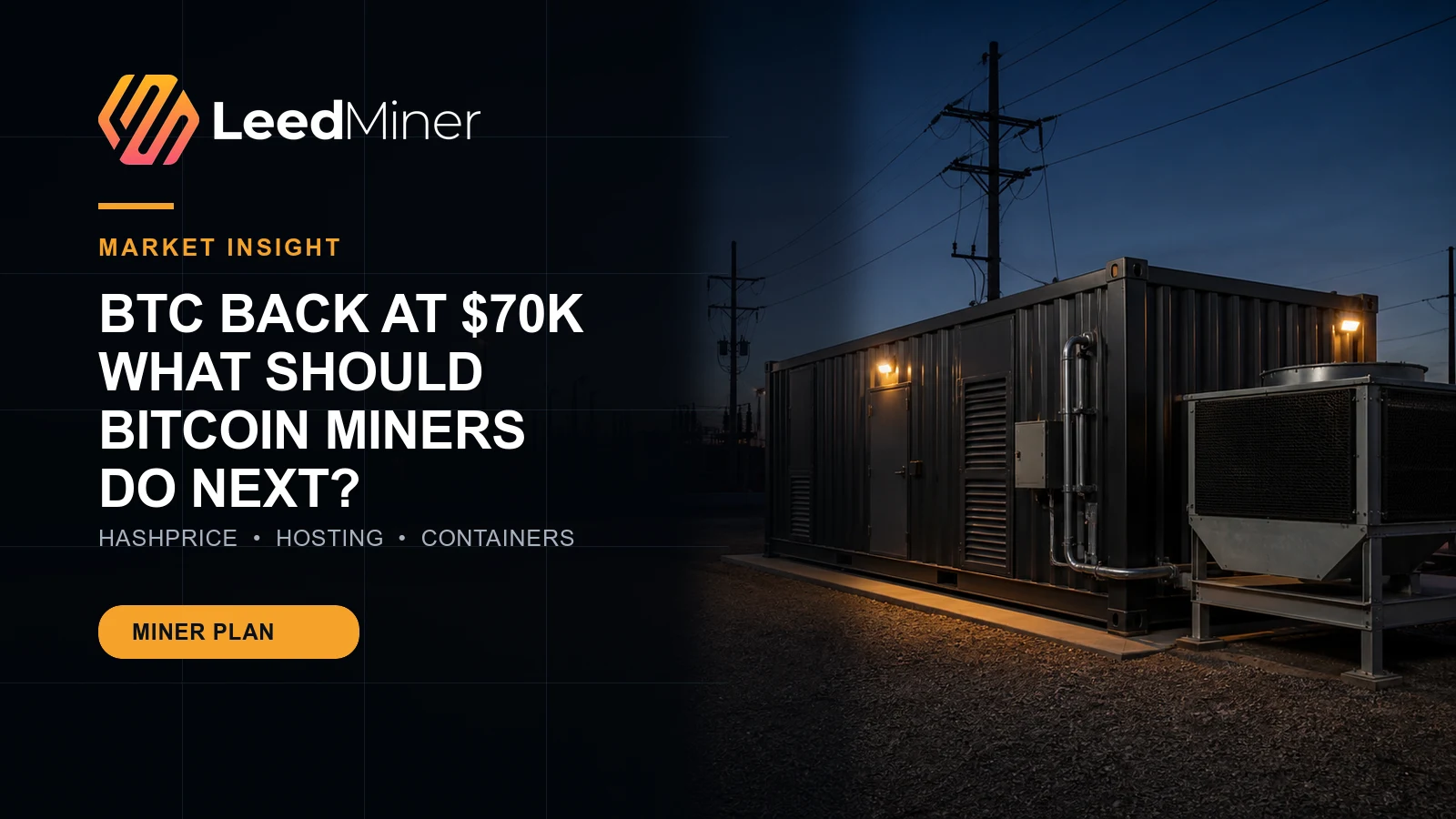
Bitcoin has moved back above $70,000, trading near $71,953 at the time of writing. That is welcome relief for miners, but it is not a return to easy economics. Network competition remains high, equipment efficiency still separates resilient fleets from marginal ones, and a stronger BTC price can be absorbed by the next difficulty adjustment. The correct question is not “Is mining profitable again?” It is “Which machines, power contracts and deployment models now have enough margin to stay online?”
This guide compares three currently published, in-stock SHA-256 miners, estimates how much daily revenue has recovered, and explains when professional hosting or a modular mining container makes more sense than adding machines to an unsuitable site.
How much did miner revenue recover when BTC crossed $70K?
A recent Hashrate Index snapshot showed Bitcoin hashprice at $31.23 per PH/s/day with BTC at $63,019. A live CoinGecko quote later put BTC near $71,953. If BTC-denominated block revenue, transaction fees, network difficulty, pool fees and uptime remain unchanged, the higher exchange rate lifts estimated USD hashprice to about $35.66 per PH/s/day. That is a 14.2% gross-revenue recovery.
The assumption matters. Bitcoin difficulty is recalibrated every 2,016 blocks, as described in the Bitcoin developer guide. If more hashrate comes online, difficulty can rise and remove part of the price benefit. The figures below are therefore a transparent spot comparison, not a revenue promise.
Three-machine comparison: gross revenue and hosted margin
The table uses the $31.23 and $35.66 hashprice scenarios above. “Net at $0.06” and “Net at $0.08” subtract only hashrate-unit power consumption multiplied by 24 hours and the stated all-in energy rate. Pool fees, downtime, maintenance, taxes, financing, container auxiliary load and equipment cost are excluded.
| Miner | Cooling | Hashrate | Power | Efficiency |
|---|---|---|---|---|
| Antminer S21 XP | Air | 270 TH/s | 3,645 W | 13.5 J/TH |
| Antminer S23 Hyd | Hydro | 580 TH/s | 5,510 W | 9.5 J/TH |
| WhatsMiner M73S+ | Hydro | 570 TH/s | 7,125 W | 12.5 J/TH |
| Miner | Gross at $63K | Gross near $72K | Daily recovery | Net at $0.06/kWh | Net at $0.08/kWh |
|---|---|---|---|---|---|
| Antminer S21 XP | $8.43 | $9.63 | +$1.20 | $4.38 | $2.63 |
| Antminer S23 Hyd | $18.11 | $20.68 | +$2.57 | $12.75 | $10.10 |
| WhatsMiner M73S+ | $17.80 | $20.32 | +$2.52 | $10.06 | $6.64 |
Gross revenue rises 14.2% for all three because the scenario changes only BTC price. Net operating income rises faster because power cost is fixed in dollars: at $0.06/kWh, estimated energy-only net improves by about 37.6% for the S21 XP, 25.2% for the S23 Hyd and 33.5% for the M73S+. At $0.08/kWh, the increases are about 83.4%, 34.1% and 61.2%. Those larger percentages reflect low starting margins, not free money.
What each machine is best suited for
Antminer S21 XP: The 270 TH/s air-cooled unit is the simplest of the three to deploy. It fits established air-cooled hosting and smaller industrial rooms without a liquid loop. Its lower purchase price reduces capital exposure, but its daily dollar cushion is thin at expensive power. It is better for operators who already have disciplined airflow, affordable capacity and a clear curtailment plan.
Antminer S23 Hyd: At 580 TH/s and 9.5 J/TH, it converts each kilowatt-hour into more hashrate than the other two models. The advantage is meaningful when margins compress. It also requires a correctly engineered hydro loop, compatible voltage, pumps, heat rejection, controls and leak management. This is a fleet or container decision, not a plug-and-play home upgrade.
WhatsMiner M73S+: The 570 TH/s unit delivers nearly the S23 Hyd’s gross revenue with a lower listed acquisition price, but it draws more power. That can make it attractive where hydro infrastructure already exists and capital budget is tighter, while the S23 Hyd remains stronger where energy cost or power capacity is the binding constraint.
Antminer S21 XP 270 TH/s

Air cooling · 3,645 W · 13.5 J/TH · In stock
Antminer S23 Hyd 580 TH/s

Hydro cooling · 5,510 W · 9.5 J/TH · In stock
WhatsMiner M73S+ 570 TH/s

Hydro cooling · 7,125 W · 12.5 J/TH · In stock
Hosting: buy uptime and operational discipline, not only cheap power
Professional hosting can improve survival odds when home or commercial power is expensive, noisy or capacity-constrained. The contract should state the real all-in rate, deposit, minimum term, uptime calculation, curtailment rules, repair labor, parts approval, pool access, insurance, termination rights and return-shipping process. A headline energy rate without these terms is incomplete.
Compare facilities using realized cost per online machine-hour. A nominal $0.06/kWh site with repeated outages can produce less BTC than a stable $0.07 site. Ask for meter evidence, maintenance response times, ambient and coolant limits, spare capacity, network redundancy and the procedure for moving hardware if economics change. Review LeedMiner’s home mining versus hosting guide before signing.
When a mining container is the better move
A container becomes useful when the operator controls land and power but lacks a ready mining building. It packages distribution, networking, airflow or liquid cooling, controls and fleet organization into a repeatable block. Containers also support phased expansion: commission one block, measure it, then add capacity instead of overbuilding an entire site.

Explore LeedMiner container solutions
The container price is only one line in the project budget. Include transformer and switchgear, civil work, freight, crane placement, commissioning, network, fire and leak protection, pumps or fans, water treatment, auxiliary energy, spares and permits. Air containers offer simpler maintenance but need strong dust and heat management. Hydro containers can support denser, more efficient fleets, but loop chemistry, flow, pressure and heat rejection become operational responsibilities. The Cambridge Bitcoin Electricity Consumption Index highlights why electricity cost and hardware efficiency are central to the economic life of mining equipment.
What miners should do now
- Recalculate every machine at today’s hashprice and at a stress case 20% lower.
- Rank the fleet by J/TH and true all-in power cost; curtail the weakest units first.
- Choose hosting when you need lower-cost power and outsourced operations; choose a container when you control a suitable site and want modular capacity.
- Require an engineering match between miner cooling type, voltage, rack or container design and available megawatts.
- Preserve cash for deposits, repairs and difficulty changes instead of treating one price jump as a permanent margin.
BTC above $70,000 gives miners breathing room, not permission to ignore costs. The strongest position combines efficient hardware, a verifiable power contract and infrastructure that can keep the fleet online through the next price and difficulty cycle. Use the LeedMiner profit calculator, review current Bitcoin miners, and contact LeedMiner for a dated equipment, hosting or container deployment quote.