


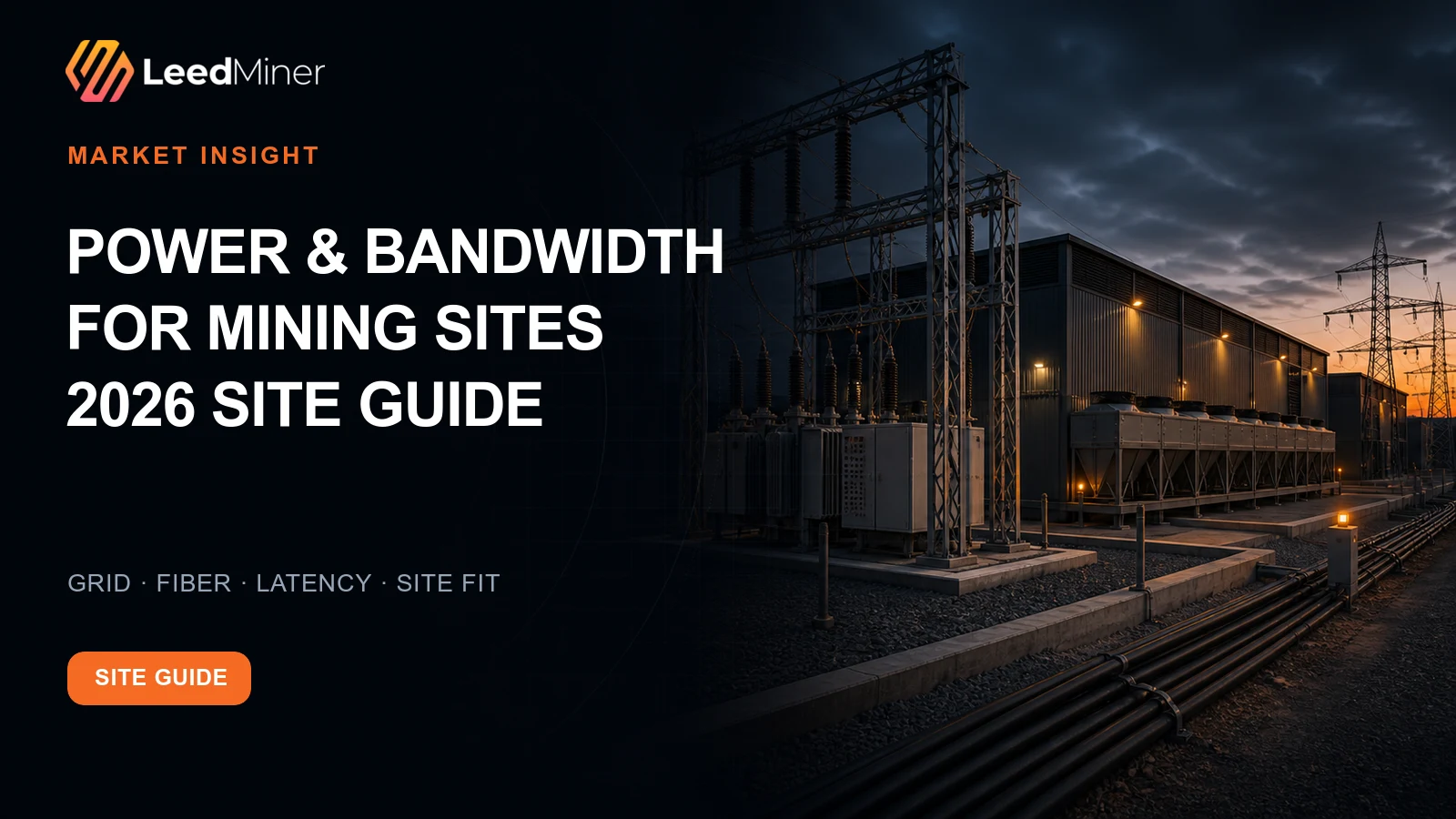
Bitcoin mining and AI data centers can compete for the same scarce input—energized land—but they do not value every site in the same way. A Bitcoin ASIC facility mainly needs reliable power, stable low-latency pool connectivity and enough bandwidth for monitoring, firmware and operations. An AI campus may need the same megawatts plus far denser fiber, interconnection and internal networking. In 2026, the practical site-selection question is therefore not simply “How many megawatts are available?” It is “What workload can this power-and-network combination support?”
Canaan’s August 6 industry note, Power Says Where. Bandwidth Says What, describes this split between power-led Bitcoin mining sites, remote AI-training campuses and latency-sensitive inference locations. This LeedMiner guide turns that theme into a procurement and due-diligence checklist. It does not assume that a mining site can automatically become an AI data center, or that a fiber-rich property is commercially viable before electrical delivery is secured.
Why Bitcoin mining can use power-rich remote sites
A Bitcoin miner repeatedly receives work from a pool and returns shares that prove hashing activity. The traffic volume is modest compared with moving AI training datasets or serving inference requests, but network quality still matters. Packet loss, unstable routing and excessive latency can delay share submission and increase stale or rejected work.
For a mining site, prioritize these network checks:
- two independent internet paths where practical;
- measured round-trip latency to primary and backup pool endpoints;
- packet-loss monitoring during peak local usage and bad weather;
- automatic failover that has been tested under load;
- secure remote administration separated from miner-management networks;
- enough capacity for firmware distribution, logging, cameras and staff—not only pool traffic.
Satellite or fixed wireless may make an otherwise remote site usable, but a sales brochure is not evidence of uptime. Run a multi-week test from the exact property and record outages, jitter and failover behavior. Keep primary and backup pools in the miner configuration and compare dashboard hashrate with pool-side accepted hashrate.
AI training and inference have different location requirements
“AI data center” is not one uniform workload. Training clusters exchange large volumes of data between accelerators, storage and adjacent systems. Their internal fabric can be extremely demanding, while some training jobs tolerate a remote campus better than interactive services do. Inference serves applications and users continuously; latency to population centers, cloud regions and exchange points can become a defining constraint.
Canaan’s note cites a McKinsey analysis of AI workload and hyperscaler strategy to distinguish latency-tolerant training from latency-sensitive inference. The operational implication is simple: a remote, power-rich mining property may have optionality for some batch-compute uses, yet remain poorly positioned for metropolitan inference.
Do not value a site from a map line that says “fiber nearby.” Confirm the carrier, route, strand or wave availability, construction responsibility, recurring cost, installation interval, service-level agreement and whether the two advertised paths share the same physical corridor.
Power availability is more than a utility letter
An interconnection position, feasibility letter or substation proximity does not equal energized capacity. Before equipment procurement, document:
- contracted capacity and the date it becomes firm;
- voltage, transformer and switchgear scope;
- who funds network upgrades and line extensions;
- demand charges, coincident-peak rules and power-factor penalties;
- curtailment rights, notice periods and restart procedures;
- seasonal ambient conditions and cooling limits;
- commissioning milestones and remedies for delay.
Bitcoin mining is unusually useful as controllable load because machines can be curtailed and restarted more quickly than many industrial processes. That flexibility can improve a site’s relationship with variable generation or grid constraints, but only when dispatch rules, metering and economic compensation are written clearly. A curtailment program that interrupts the fleet during the highest-value mining hours may still damage project economics.
Use the LeedMiner profit calculator to test miner-level electricity scenarios, then add facility loads, demand charges, curtailment and downtime in a separate site model.
Build a two-axis site scorecard
Score every candidate property on power and connectivity separately instead of hiding both inside one “infrastructure” grade.
Power score
- firm megawatts today and expansion rights;
- delivered energy cost and demand-charge exposure;
- power quality, redundancy and outage history;
- transformer, switchgear and spare-parts lead time;
- cooling-water or heat-rejection constraints;
- curtailment flexibility and revenue treatment.
Connectivity score
- carrier diversity and physically diverse entrances;
- measured latency to pools, cloud regions and exchanges;
- packet loss, jitter and repair history;
- dark fiber, wavelength or IP-transit availability;
- construction cost and delivery schedule;
- monitoring, security and out-of-band management.
A mining-only site can accept a lower connectivity score than an inference campus, but it should never accept an untested single point of failure. An AI conversion thesis needs an engineering study, carrier commitments and a realistic capital plan rather than a higher valuation based on the word “AI.”
Hardware density changes the electrical decision
Newer ASICs produce more hashrate per rack position and may reduce the number of units needed for a target capacity. The trade-off is concentrated heat and a higher consequence when one circuit, switchboard or airflow path is undersized. Verify the exact model, nameplate power, batch and cooling method before approving a site layout.
The following LeedMiner listings were published and in stock when checked on August 10, 2026. Prices and stock can change; use the live pages and a current quotation for the final decision.
Product card — Canaan Avalon A16 XP (300 TH/s) Listed at $5,600.00 with 3,850 W catalog power when checked. This high-density air-cooled unit is useful for testing whether switchgear, airflow and network monitoring scale with newer hardware. View the Avalon A16 XP
Product card — Canaan Avalon A16 (282 TH/s) Listed at $4,200.00 with 3,900 W catalog power. Confirm the available batch, input requirements, freight and warranty before modeling deployment timing. View the Avalon A16
Product card — Canaan Avalon A15 Pro (221 TH/s) Listed at $2,011.00 with 3,713 W catalog power. Compare its hashrate, efficiency and total installed cost with the A16 generation rather than comparing purchase price alone. View the Avalon A15 Pro
If a live listing has no price, label the commercial field Inquiry and request a dated quotation. Do not treat a missing price as a pending promise.
When a mining-to-AI conversion thesis is credible
A conversion thesis becomes credible only when the site has evidence for both sides of the equation. On the power side, that means firm delivery, scalable electrical infrastructure and a cooling design compatible with the proposed density. On the network side, it means committed fiber, route diversity, documented latency and a provider willing to support the required service level.
The building also matters. AI equipment may require different floor loading, fire protection, humidity control, physical security, backup power, maintenance practices and uptime targets. A containerized mining yard with excellent megawatts is not automatically a data center shell. Conversely, a well-connected warehouse without firm power is not ready for either workload.
Use staged gates:
- Gate 1 — evidence: utility, carrier and property documents are verified;
- Gate 2 — design: electrical, cooling and network engineers produce a coordinated basis of design;
- Gate 3 — economics: mining, training and inference scenarios are modeled separately;
- Gate 4 — pilot: a limited deployment proves power quality, cooling, connectivity and operations;
- Gate 5 — scale: procurement begins only after the pilot evidence matches the model.
Final site-selection checklist
Before buying miners or paying a premium for compute optionality, verify firm power date, delivered tariff, demand charges, curtailment, transformer and switchgear scope, cooling capacity, carrier routes, measured latency, packet loss, repair time, cybersecurity, permits, freight and warranty support. Keep the Bitcoin-mining case viable on its own; treat any future AI use as a separate engineering and commercial case.
Compare current Bitcoin mining hardware, model exact devices in the ASIC comparison tool, and contact LeedMiner with your country, voltage, available megawatts, electricity tariff, cooling method and connectivity profile. LeedMiner can prepare a hardware shortlist and dated quotation while your project team validates the site.