
Home
Product
Container Solutions
Profit Ranking
HostingBlog
About Us

Site preferences

Appearance
HomeProductContainer SolutionsProfit Ranking
HostingContact UsFAQs
BlogCoin ListMiners' ProfitabilityExhibitions
AboutOur TeamPartnersStaff Authentication
ENESFRDEITPTNLRUARJAKOZH-CN
Login
CartLeedMiner

Your cart is empty

Browse products or send a quote request when you are ready.

Browse miners
Home/Blog/Bitaxe Gamma Turbo GT Review: Dual-BM1370 Home Mining
Back to Blog

Bitaxe Gamma Turbo GT Review: Dual-BM1370 Home Mining

MinersMarch 28, 20256 min read
March 28, 20256 minutes readUpdated August 15, 2026

A practical 2026 Bitaxe Gamma Turbo GT review covering dual-BM1370 hardware, 2.4 TH/s performance, 35 W power, cooling, setup, and current alternatives.

By LeedMiner Editorial
XFacebookLinkedIn
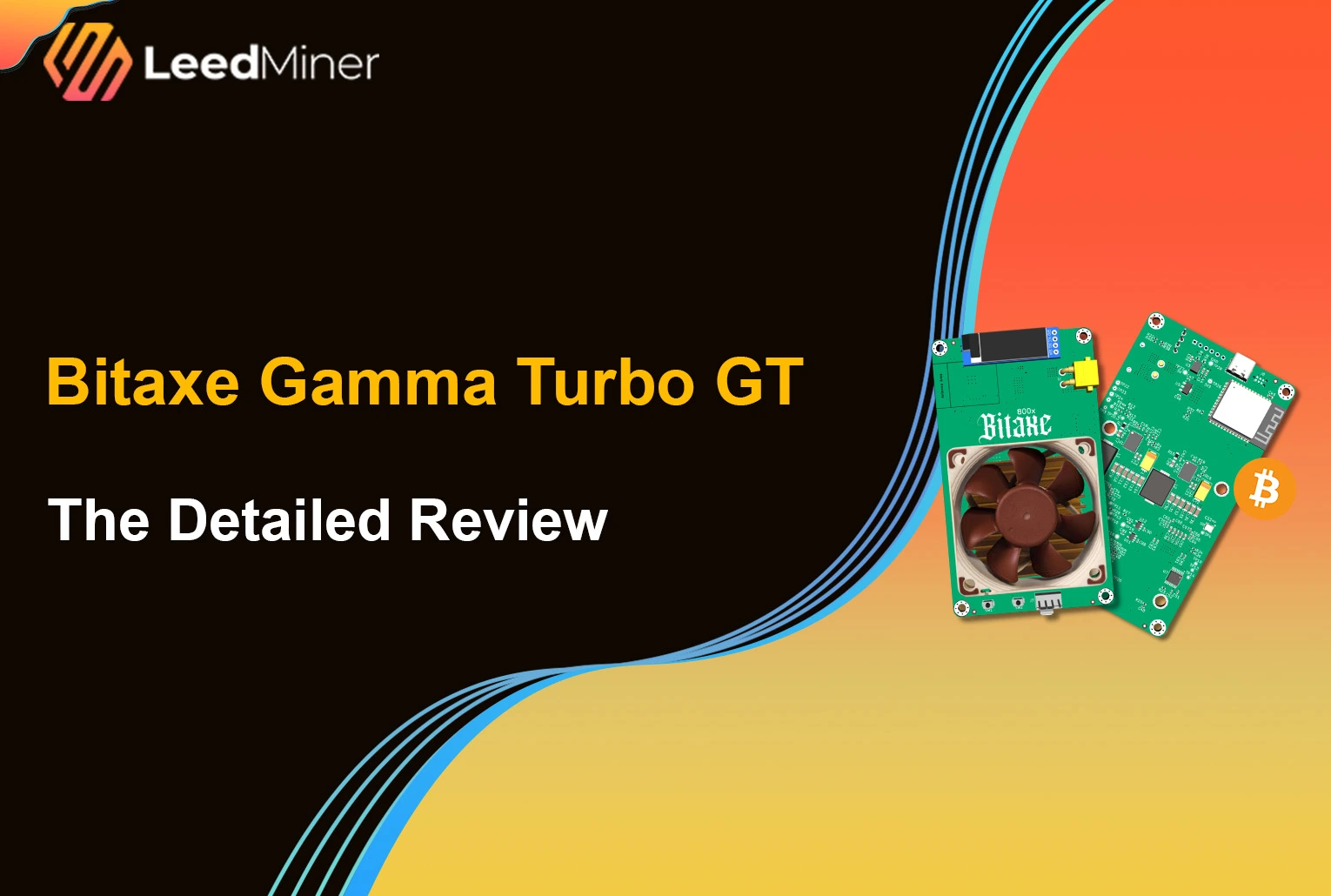
LeedMiner editorial cover featuring the real Bitaxe GT 800 dual-BM1370 miner for a detailed Gamma Turbo review

Share Article

XFacebookLinkedInPinterestWhatsAppTelegram

Table Of Contents

What the Gamma Turbo GT isHashrate, power, and efficiencyCooling matters more with two chipsPower supply and network setupHow it compares with a single-chip Gamma-class minerCurrent in-stock optionsBitaxe GT 800 2.4 TH/sNerdaxe Gamma 601 1.2 TH/sWho should buy the GT 800?Verdict

The Bitaxe Gamma Turbo GT takes the open-source Bitaxe idea from one BM1370 ASIC to a dual-chip board. That change raises hashrate, power demand, cooling requirements, and the importance of a stable power supply. It does not turn a desktop miner into an industrial revenue machine. The strongest reasons to choose it are hands-on Bitcoin mining, open hardware, pool experimentation, and compact solo-mining participation.

This 2026 review separates the open project from a seller's finished configuration. Board revision, enclosure, fan, power supply, firmware, and tuning can change measured results. LeedMiner's current Bitaxe GT 800 listing records 2.4 TH/s at 35 W, while project documentation describes the Gamma Turbo platform as two BM1370 chips. Confirm the exact assembled unit before ordering.

What the Gamma Turbo GT is

The official Bitaxe organization describes the Gamma Turbo 800 series as a dual-BM1370 miner based on the ASIC used in the Antminer S21 Pro. The Open Source Miners United wiki likewise identifies the Gamma Turbo as a rework of the Gamma using two BM1370 chips. Hardware design and ESP-Miner firmware are open for inspection and development, although the BM1370 silicon itself is not open source.

The practical value is transparency. Owners can inspect design files, follow firmware development, choose a Stratum V1 pool, or use solo-mining infrastructure. The trade-off is that open hardware evolves. A product called GT 800, GT 801, Gamma Turbo, or Turbo Touch may not share every connector, display, fan, firmware build, or default setting.

Bitaxe GT 800 dual-BM1370 miner photographed for the Gamma Turbo review
Bitaxe GT 800, the exact in-stock dual-chip model discussed in this review.

Hashrate, power, and efficiency

LeedMiner's published GT 800 configuration lists 2.4 TH/s, 35 W, and roughly 15 J/TH. Those numbers should be read as a product configuration, not as a universal result for every Gamma Turbo board. Hashrate depends on frequency, core voltage, chip quality, firmware, temperature, power delivery, and rejected-share rate.

At 35 W, continuous operation uses about 0.84 kWh per day or 25.2 kWh in a 30-day month. At $0.15/kWh, that is roughly $3.78 per month before pool fees or networking. Low electricity use makes the device easy to run, but low power does not guarantee fast payback. Two to three terahashes is a tiny fraction of the Bitcoin network, so revenue is variable and solo block discovery remains a low-probability event.

Cooling matters more with two chips

The single-chip Gamma project warns that active cooling is required and that higher frequency and voltage can cause overheating. A dual-chip board concentrates more heat and power on a compact platform. The heatsink must contact both ASICs correctly, the fan must receive the intended voltage, and airflow must not recirculate through an enclosure.

Begin with the seller's stock profile. Record chip temperature, regulator temperature if exposed by firmware, fan speed, accepted hashrate, hardware errors, input voltage, and wall power. Change one tuning variable at a time and test through warm ambient conditions. A higher dashboard hashrate is not an improvement if errors rise, the power connector overheats, or the device throttles.

Power supply and network setup

Use the voltage and connector specified for the exact assembled GT. Do not assume the 5 V requirements documented for a single-chip Gamma apply to every dual-chip commercial board. The supply needs adequate continuous-current headroom, a correctly sized cable, secure polarity, and a connector that stays cool. Place the unit on a stable nonflammable surface with clear intake and exhaust paths.

Connect only to trusted 2.4 GHz Wi-Fi, change default credentials, and update with firmware published for the exact board revision. Configure the pool URL, worker name, and payout address carefully. Confirm accepted shares in both the local dashboard and pool account. Never expose the management interface directly to the public internet.

How it compares with a single-chip Gamma-class miner

A single-chip BM1370 device such as the in-stock Nerdaxe Gamma 601 uses less power and produces less heat. LeedMiner lists that model at 1.2 TH/s and 18 W. The GT 800 roughly doubles the listed hashrate while keeping a similar efficiency class, but it asks more from cooling and power delivery. The right choice depends on whether you want the simplest entry point or more hashrate in one device.

Nerdaxe Gamma 601 single-BM1370 miner used as a lower-power comparison with the Bitaxe GT 800
Nerdaxe Gamma 601, the current 1.2 TH/s single-chip comparison.

Current in-stock options

LeedMiner checked these published listings on August 14, 2026. Price and stock can change, and accessories may differ by batch.

Bitaxe GT 800 2.4 TH/s

SHA-256 · 2.4 TH/s · 35 W · In stock

$148

View current product details

Nerdaxe Gamma 601 1.2 TH/s

SHA-256 · 1.2 TH/s · 18 W · In stock

$105

View current product details

Who should buy the GT 800?

Pool choice changes the experience. A conventional pool credits a small miner for submitted shares and can provide gradual payouts subject to its threshold and fees. A solo pool records work but pays only if the miner finds a valid block, so long periods with no payout are normal. Running your own node and solo infrastructure adds privacy and learning value but also increases setup and maintenance. Decide which objective matters before configuring the device; do not switch between pooled revenue and lottery-style solo mining without understanding how the payout model changes.

Keep a simple operating log with firmware version, frequency, voltage, average accepted hashrate, error rate, temperature, fan speed, wall power, and pool latency. That evidence makes tuning safer and helps separate a firmware or network problem from normal hashrate variance.

The GT 800 fits a buyer who values open hardware, wants more hashrate than a single-chip desk miner, accepts active cooling, and understands that returns are uncertain. It is also useful for learning pool configuration, monitoring, firmware, and thermal tuning without the circuit and sound demands of an industrial ASIC.

Choose the lower-power Gamma 601 class when simplicity, heat, or budget matters more. Choose a larger home miner only when you have a suitable circuit, room, and economic plan. Before buying, compare models in LeedMiner's ASIC comparison tool, test your tariff in the profit calculator, and review current miner inventory.

Verdict

The Bitaxe Gamma Turbo GT is compelling as a compact dual-chip open-source Bitcoin miner, not as a guaranteed income appliance. Its advantages are accessible power use, inspectable hardware, flexible pool choice, and meaningful hashrate for a desktop device. Its risks are configuration variation, thermal sensitivity, firmware compatibility, and unrealistic expectations about solo mining.

For a dated stock check, included-accessory confirmation, or help comparing the GT 800 with a single-chip model, contact LeedMiner with your country, electricity price, noise preference, and intended pool or solo setup.

Related Posts

LeedMiner editorial cover showing utility switchgear and substation equipment for a Bitcoin mining margin analysisAugust 21, 2026Bitcoin Mining Operating Leverage: Why BTC at $74K Can Double Miner Net Income

Why an 18% BTC-led revenue recovery can more than double net income after electricity for marginal Bitcoin miners—and wh

LeedMiner editorial cover showing an engineer inspecting power switchgear for a Bitcoin mining fleet restart decisionAugust 21, 2026Bitcoin at $74K: Which Bitcoin Miners Are Worth Restarting?

A power-cost and efficiency guide to deciding which Bitcoin miners to restart as BTC returns to $74K, including hosting

Dark LeedMiner editorial poster showing generator and electrical distribution equipment for WhatsMiner fleet restart controlAugust 20, 2026WhatsMinerTool 9.2.5: Safer Fleet Restarts and Better Mining Telemetry

A practical operator guide to WhatsMinerTool 9.2.5 random startup, remote work controls, and API 3.0.5 cumulative teleme

Need Help?

HomeCoinShopMy Account

Leedminer offers competitive miner prices, accelerating your Return on Investment (ROI).

+86 133 5291 7253info@leedminer.com

Information

  • Shop
  • My Account
  • Miners' Profitability
  • Coin List
  • Halving Countdown
  • Blog

Support

  • Contact Us
  • FAQs
  • Payment Methods
  • Return & Warranty
  • Terms & Conditions
  • Privacy Policy

Company

  • About Us
  • Our Team
  • Exhibitions
  • Partners
  • Fraud Prevention
LEEDMINER

© 2018-2026 LeedMiner All rights reserved.

We use cookies to improve your experience.

Cookie Settings

We use essential cookies for cart and account sessions. Optional analytics and marketing scripts only load after consent.

Privacy Policy