


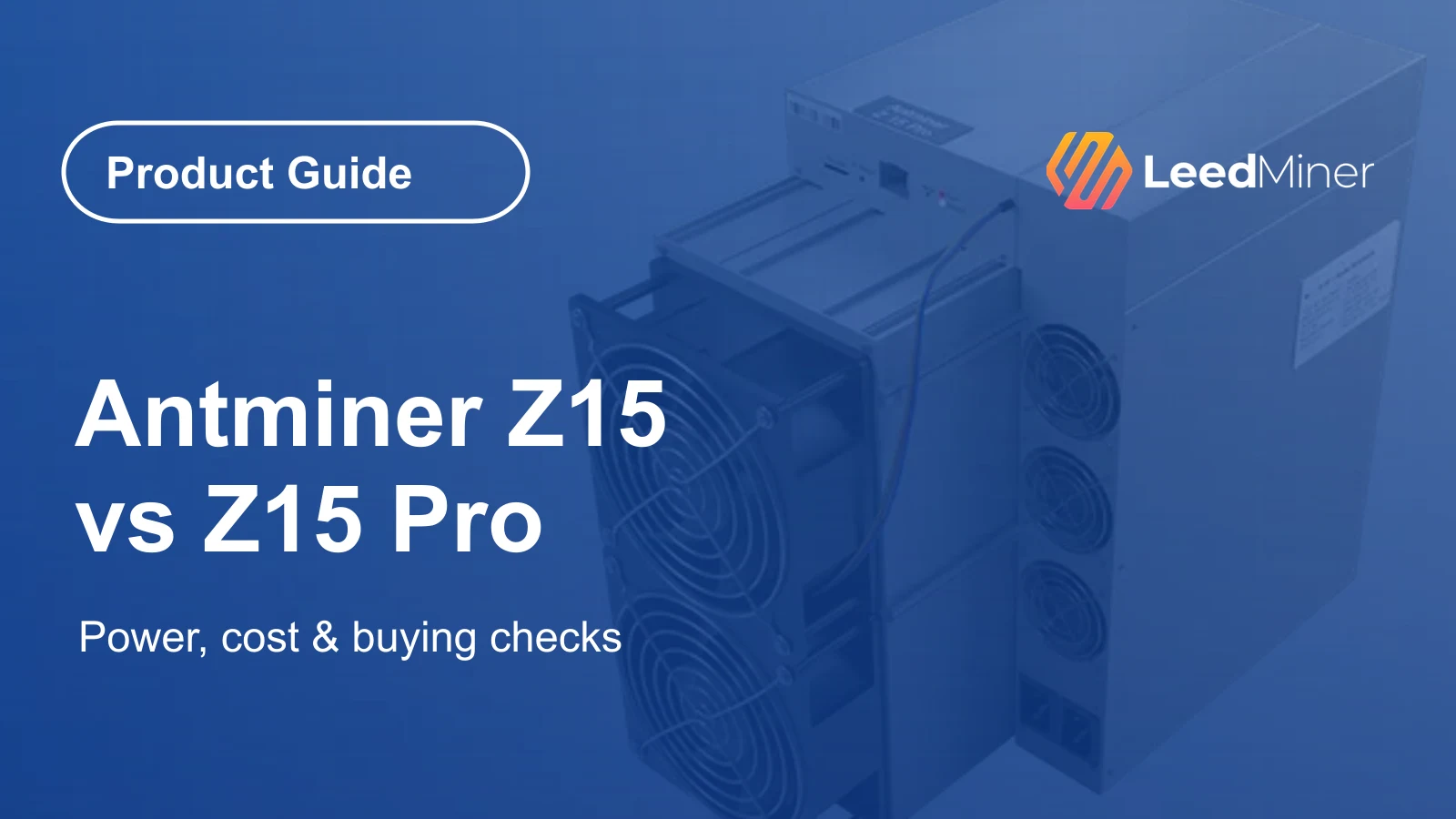
The useful distinction is not simply “older versus newer.” The standard Z15 uses less electricity per machine; the Z15 Pro 840K delivers twice the nominal hashrate with less than twice the power. If your site has room for the higher load, compare energy per unit of hashrate rather than treating the smaller electricity bill as proof of better profitability.
This guide compares the Z15 420 KSol/s with the Z15 Pro 840 KSol/s. A listing for an 860K unit is a different configuration: verify its own specifications and delivery terms. Neither a model name nor a profitability screenshot establishes the condition of the particular machine you will receive.
1. Compare the exact configuration—and check the coin network
BITMAIN's published specifications give the following reference values. These are nominal equipment figures, not measurements of a particular used unit. The efficiency figures below are calculated as wall power divided by hashrate.
| Reference configuration | Nominal hashrate | Wall power at 25°C | Calculated efficiency |
|---|---|---|---|
| Antminer Z15 | 420 KSol/s | 1,510 W | 3.60 J/KSol |
| Antminer Z15 Pro | 840 KSol/s | 2,780 W | 3.31 J/KSol |
Sources: BITMAIN Z15 setup and specifications and BITMAIN Z15 Pro specifications.
What this means: at the reference settings, the Pro has about 8% lower energy consumption per unit of hashrate. Two standard Z15 units would provide the same nominal 840 KSol/s while drawing 3,020 W, versus 2,780 W for one Pro. That comparison separates efficiency from total machine consumption. It does not account for faults, cooling overhead, downtime or individual-unit performance.
Keep the algorithm and the live network separate. Historical equipment pages may list both ZEC and ZEN, but that is not current evidence that both networks remain mineable. Horizen's official migration documentation states that ZEN moved to an ERC-20 contract on Base on July 23, 2025, with the old chains discontinued. Do not include legacy ZEN mining income in a current Z15 purchase calculation.
For a Zcash deployment, verify the current pool's supported algorithm, connection instructions and payout rules before configuring equipment. Use the Zcash miner collection to find the relevant model family, and the Equihash collection to compare hardware by algorithm. A collection page is a discovery aid, not a guarantee that every listed configuration is immediately available.
2. Calculate electricity costs before estimating payback
A repeatable calculation is more useful than an undated “profit per day” figure. Start with electricity consumption:
Daily electricity cost = wall power in kW × operating hours × electricity tariff.
The table assumes 24 hours of operation at the reference wall power, with no cooling or distribution overhead. The tariffs are illustrative scenarios, not LeedMiner hosting offers or forecasts.
| Electricity tariff | Z15: 36.24 kWh/day | Z15 Pro: 66.72 kWh/day |
|---|---|---|
| $0.05/kWh | $1.81/day | $3.34/day |
| $0.08/kWh | $2.90/day | $5.34/day |
| $0.12/kWh | $4.35/day | $8.01/day |
The standard Z15's daily bill is smaller because it performs less nominal work. At equal hashrate, the reference Pro configuration uses 5.76 kWh less per day than two standard Z15 units. At the illustrative $0.08/kWh tariff, that is about $0.46 per day in electricity savings, before any site overhead. This calculation is not a net-profit estimate.
Next, build a separate revenue scenario using current network and pool information. Record the date, coin price assumption, difficulty or network hashrate, reward assumptions, pool fees, expected uptime and the machine's accepted hashrate. Keep gross revenue separate from the payout received after fees. A revenue estimate made under one set of network conditions should not be presented as a continuing daily return.
Operating cash flow also needs to cover charges outside the miner's wall consumption: cooling, hosting service fees, repairs and other agreed costs. Use measured site consumption where available, and check whether a hosting tariff includes these items. The hosting page is the right starting point for discussing deployment requirements; confirm the actual contract rather than importing an illustrative tariff from this article.
For a simple payback scenario, divide the complete acquisition and deployment cost by a positive estimated daily operating cash flow. Include freight, applicable taxes, power equipment and setup—not just the machine. If cash flow is zero or negative, a finite payback period is not supported under that scenario. Even when it is positive, the result is a scenario, not a promised recovery date. Recalculate when network conditions, fees or operating performance change.
3. Inspect condition, power requirements and delivery terms
A used machine should be assessed as a specific asset, not as an average example of its model. Ask for a dated operating report tied to the serial number, with board status, temperatures, fan behavior, accepted hashrate and a sufficiently long observation period to reveal intermittent faults. Compare the pool-side record with the local dashboard rather than relying on one screenshot taken just after startup.
Ask what has been repaired, whether the power supply and required leads are included, and which party handles a failure after delivery. Get the warranty scope and remaining period in writing. “Used,” “refurbished” and “out of warranty” describe different risks; they should not be collapsed into a generic in-stock label. Packaging condition and evidence of corrosion or overheating also deserve attention before a purchase decision.
The Pro reference specification lists 200–240 V AC input. Have a qualified installer check the exact equipment label, circuit capacity, grounding, connectors and local electrical requirements. Do not assume an ordinary household outlet is suitable. Plan ventilation and noise isolation for either model; a lower-power ASIC is not automatically a quiet home appliance. Where your location lacks suitable power or heat removal, compare a properly specified hosting arrangement rather than improvising the installation.
Check the precise delivery option too. A future batch, a stated lead time and ready stock are different commitments, even when the underlying product page uses the same model name. Confirm location, dispatch window, condition, warranty and the selected configuration before proceeding. The older used Z15 is retained here as a technical reference, not represented as an available purchase option.
Current product reference
Antminer Z15 Pro 840K
Air cooling · 2,780 W reference power · 3.31 J/KSol · Confirm the selected delivery batch.
Use the ASIC comparison tool for current catalog comparisons, then confirm the exact configuration and operating assumptions with the team. Do not transfer figures from the 840K reference configuration to another hashrate version without checking that version's data.