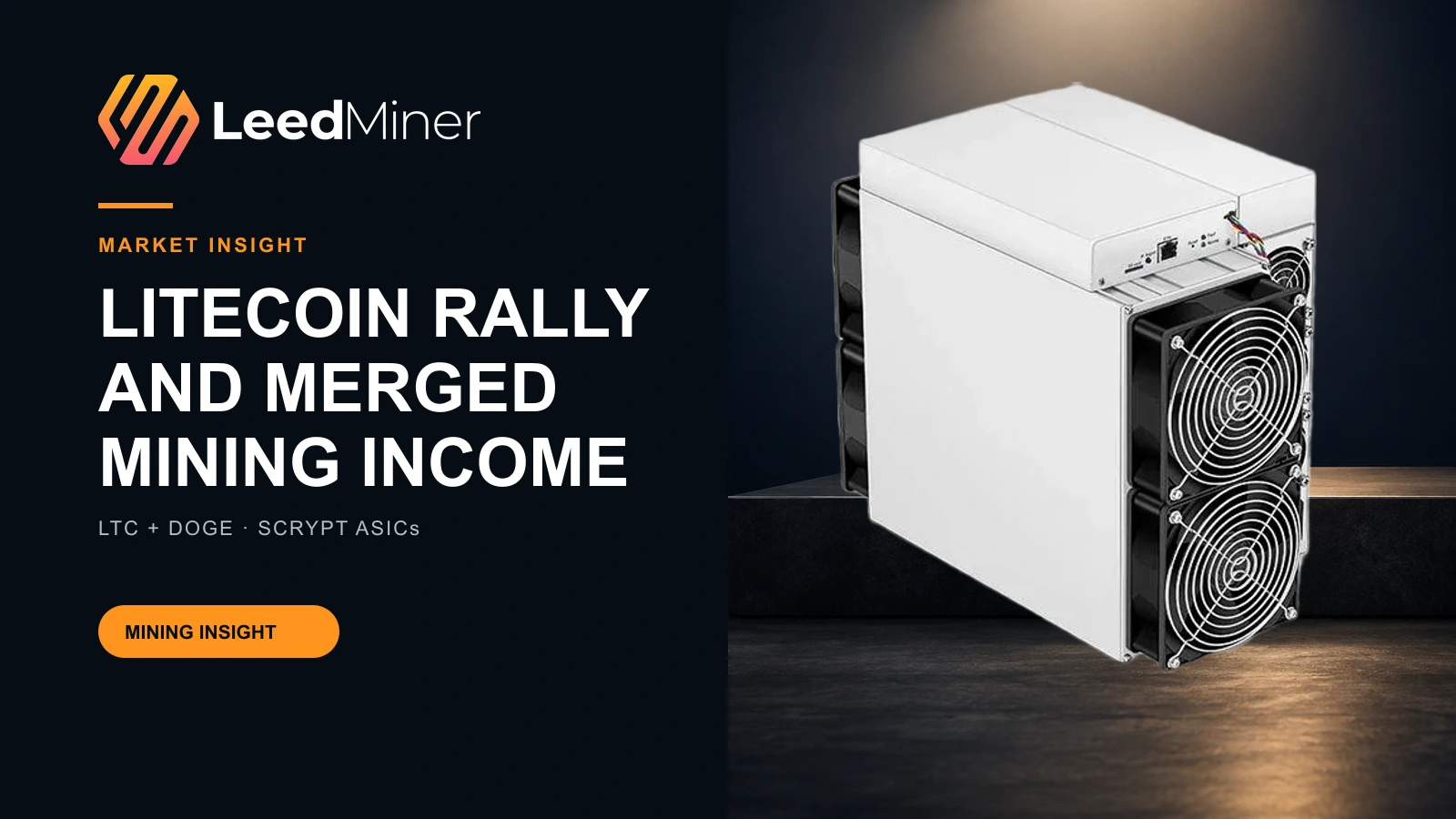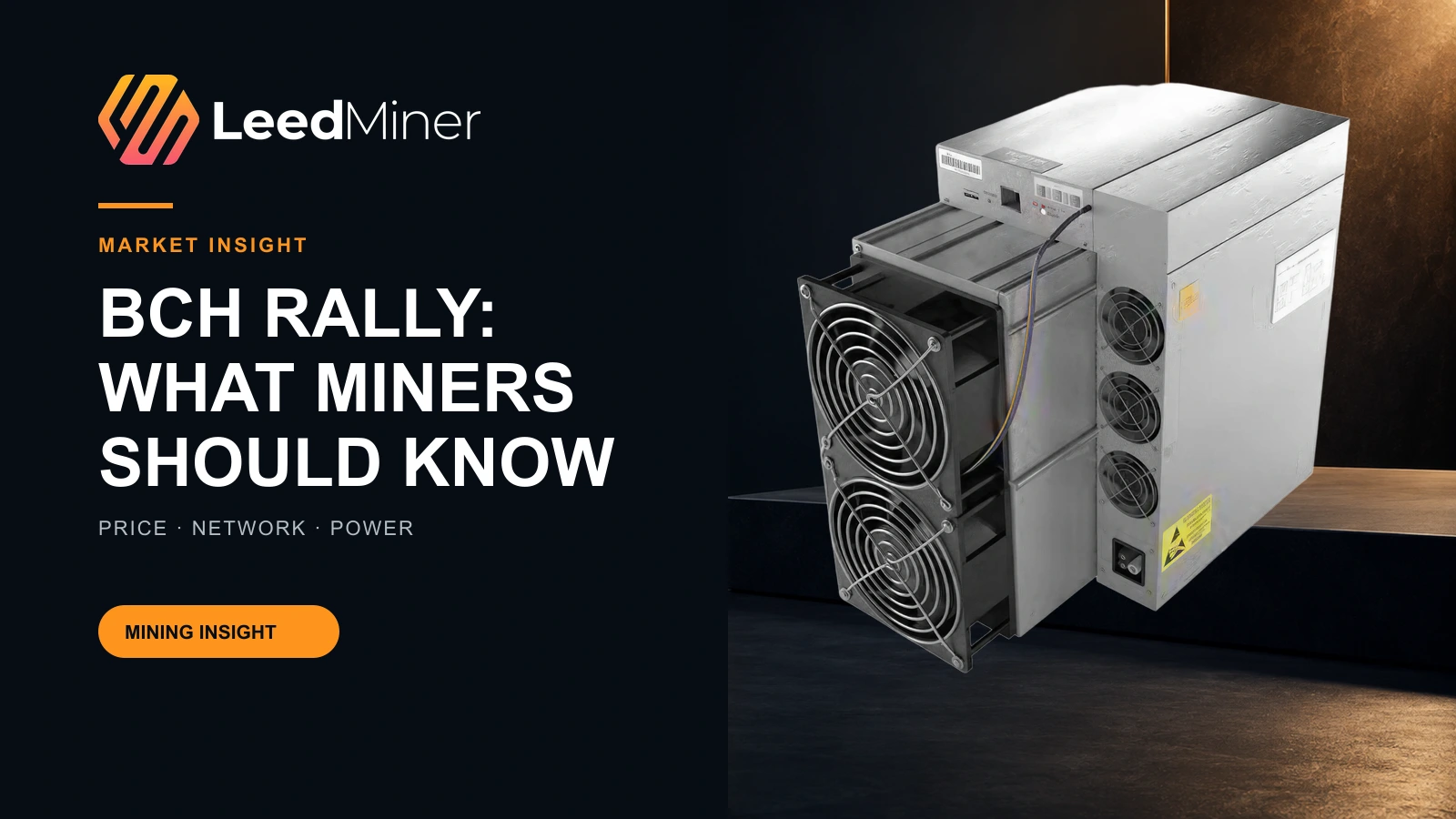



SHA-256 and Scrypt are not two settings on the same ASIC. They are different proof-of-work workloads, and a fixed-function miner must be built for the algorithm it will run. That single fact should come before hashrate, power, pool choice or expected revenue. A Bitcoin-focused SHA-256 machine cannot be redirected to Litecoin simply by changing a pool URL, and a Scrypt machine cannot mine Bitcoin.
This guide turns that algorithm boundary into a practical buying and deployment workflow. Technical facts come from the Bitcoin Developer documentation, the official Litecoin project repository and current BITMAIN support material. The LeedMiner catalog is used only to confirm that the exact product examples below are published, visible, in stock and media-ready. No equipment sales prices are shown.
Key takeaways
- Choose the coin and algorithm before choosing hardware.
- Do not compare TH/s and GH/s across different algorithms as if they measured equivalent work.
- Verify wall power, voltage, cooling, noise and site capacity for the exact model.
- Confirm the pool supports the intended coin, earning mode and payout address.
- Commission one worker and test primary and backup endpoints before scaling a fleet.
Why SHA-256 and Scrypt require different ASIC hardware
Bitcoin mining applies double SHA-256 to an 80-byte block header and searches for a hash below the network target. The official Bitcoin Developer mining guide describes mining software sending the header and target to ASIC hardware, which repeatedly changes nonce-related work and tests hashes. A SHA-256 ASIC makes this narrow operation extremely fast by implementing it directly in fixed silicon.
Litecoin uses a different proof-of-work function. The official Litecoin project documentation records Scrypt with the network's parameters and the project source contains the current Scrypt implementation. Although both systems ultimately compare a result with a target, the sequence of operations, memory behavior and optimized circuit design are different. An ASIC created for one workload does not contain a general reprogrammable path for the other.
This is why a model name, cooling method or electrical connector cannot establish coin compatibility. Read the exact specification line for “crypto algorithm/coins,” then confirm the current network and pool requirements. BITMAIN lists the Antminer S21 XP as SHA-256 hardware for BTC, BCH and BSV, while its L9 installation guide identifies the L9 as Scrypt hardware for LTC, DOGE and BEL. A pool may support fewer earning modes than the hardware specification suggests, so hardware capability and pool support are separate checks.
Hashrate units also stay inside their own algorithm context. The S21 XP is measured in terahashes per second and the L9 in gigahashes per second, but the numbers do not describe equivalent calculations. Dividing one by the other does not tell you which machine is “faster” or more profitable. Compare a miner with other machines running the same algorithm, then model that network's difficulty, rewards, pool terms, uptime and electricity cost.
Compare power, efficiency, voltage, heat and noise before choosing
Once the algorithm is correct, move from headline hashrate to the complete site envelope. BITMAIN's official S21 XP specification gives typical values of 270 TH/s, 3,645 W and 13.5 J/TH, with 220–277 V AC input. The official L9 installation guide lists the 15 GH/s version at 3,150 W and 210 J/GH with the same stated voltage range. These efficiency units belong to different algorithms and should not be ranked against each other.
At typical wall power, one S21 XP represents about 87.48 kWh of energy over 24 hours, while the 15 GH/s L9 represents about 75.6 kWh. Those are simple nameplate illustrations, not a revenue forecast. Actual energy use varies with inlet temperature, firmware, voltage, unit tolerance and downtime. Add ventilation, networking and distribution losses when sizing a site, and use measured wall power for operating decisions.
Nearly all electrical input ultimately becomes heat in the room. Confirm cool-air supply, hot-air removal, recirculation control, intake limits, filtration and service clearance. BITMAIN states a maximum-condition noise value of 76 dBA for the S21 XP; the LeedMiner catalog records 75 dBA for the exact L9 listing. Real-room sound depends on fan speed, surfaces, ducts, vibration paths and distance. Neither machine should be treated as quiet household equipment without a measured acoustic and ventilation plan.
| Algorithm reference | Exact model | Typical hashrate | Wall power | Efficiency | Cooling | Catalog state |
|---|---|---|---|---|---|---|
| SHA-256 | Antminer S21 XP | 270 TH/s | 3,645 W | 13.5 J/TH | Air | In stock |
| Scrypt | Antminer L9 | 15 GH/s | 3,150 W | 210 J/GH | Air | In stock |
Before purchase, have a qualified professional verify circuit capacity, conductor size, receptacle and PDU compatibility, grounding, protection and local rules. BITMAIN's power-cord reference shows that model-specific cord details matter even when two miners share a voltage range. For larger fleets, compare the electrical, cooling and operations scope of managed hosting instead of assuming a local room can absorb continuous multi-kilowatt loads.
Match the algorithm to coins, pools and commissioning
After selecting hardware, verify the revenue path end to end. Start with the intended coin, then confirm the pool's current algorithm, endpoint, region, port, account format, payout asset, fee method and minimum payout. A SHA-256 pool URL does not automatically support every SHA-256 coin, and a Scrypt pool may offer Litecoin-only settlement, merged-mining rewards or a converted payout under different terms.
Merged mining needs careful wording. A Scrypt miner may contribute work to a pool that accounts for Litecoin and compatible auxiliary networks, but that does not make the machine multi-algorithm. The pool constructs compatible work and controls how rewards are credited. Read the operator's current documentation and verify which payout addresses are required. The same principle applies to SHA-256 pools that support multiple networks or automatic conversion.
Commission one worker first. Record the exact firmware source and version, primary and backup pool URLs, worker naming convention, payout address, DNS and time settings. Observe miner-side hashrate, pool-side accepted hashrate, rejected or stale shares, temperatures, fan behavior, wall power and reconnect time. Test failover deliberately during a maintenance window, then confirm that the worker returns to the intended primary route.
Run the pilot long enough to see a complete accounting and payout cycle. Compare pool-side results with the miner log, and document who can change pool credentials or payout settings. Use unique credentials, multi-factor authentication where available and role separation for monitoring versus treasury changes. A valid algorithm and a working network cable are only the beginning; stable operations require repeatable configuration, alerting and change control.
Use the LeedMiner comparison tool to compare exact models within the same algorithm and the profit calculator to test electricity and uptime assumptions. Treat every output as a scenario rather than a guarantee, and refresh difficulty, reward and pool inputs before acting.