



Before buying a hydro-cooled ASIC, ask for a documented match between the exact miner, the cooling circuit and the intended operating mode. A label saying “water cooled” does not establish compatibility. The useful deliverable is a small, traceable document pack: the model manual, an identified circuit drawing, the approved fluid specification, test records and a named commissioning owner.
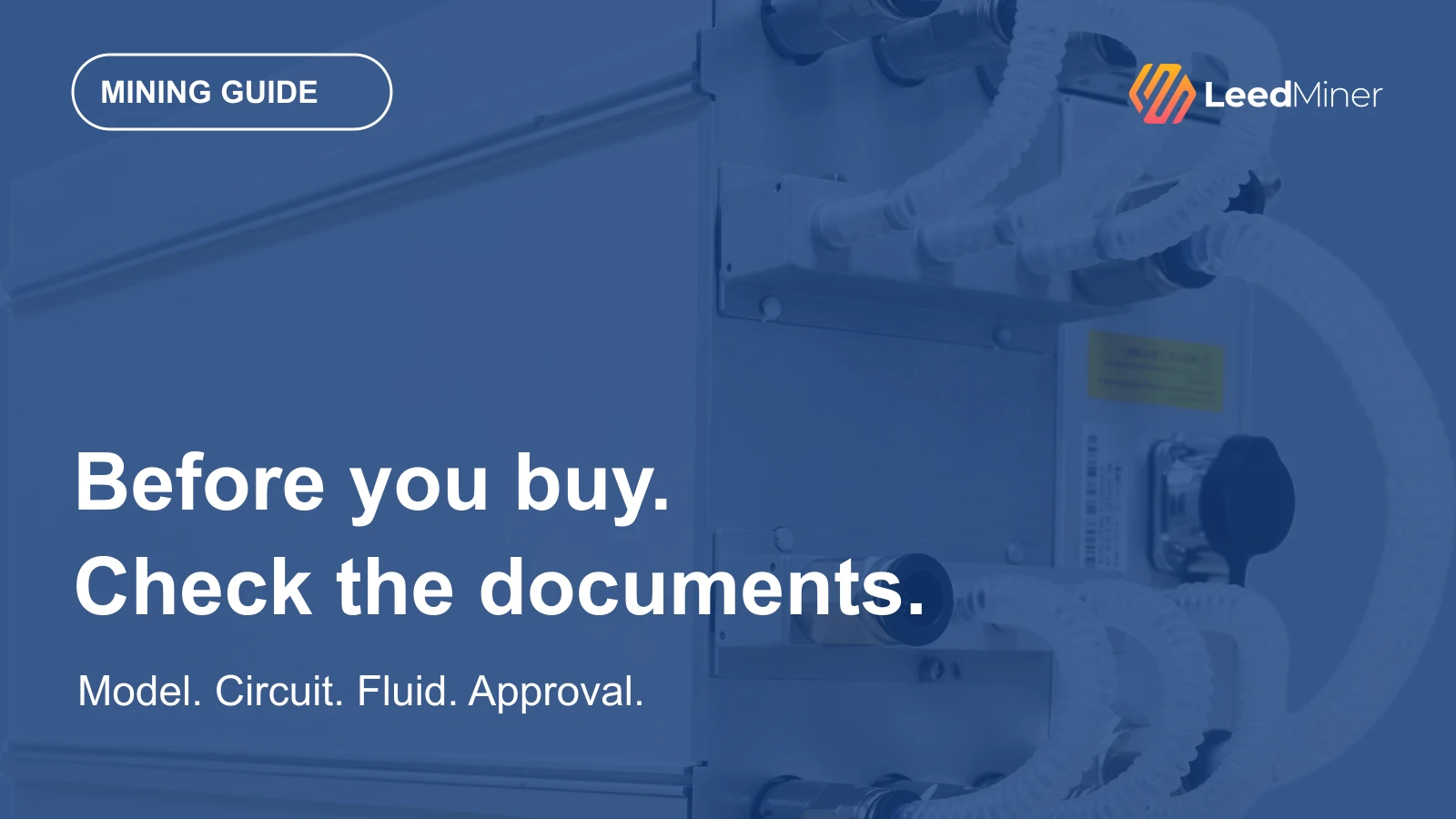
This guide is a purchasing and document-review checklist, not a coolant recipe or an installation procedure. Qualified site personnel must approve the final design and follow the applicable manufacturer instructions. The equipment photograph is illustrative; it does not identify a tested installation or a reserved shipment.
Start with the exact model and document revision
Record the full model, hardware version, quoted batch and planned mode before collecting cooling figures. Keep the original manual filename, revision, publication date and manufacturer URL beside every requirement. An undated screenshot separated from its notes is a weak basis for approving equipment.
The WhatsMiner hydro-cooling operation-guide page identifies a specific group of models and an example machine. That stated scope matters: a guide is not automatically evidence for every newer hydro model. Ask the supplier which document applies to the units being offered and retain their written answer with the quotation.
For a broader comparison of facility architectures, use our hydro-cooling infrastructure guide. Here the narrower question is which evidence must be complete before procurement moves forward. A model-selection comparison and a supplier document pack serve different decisions.
Separate the circuits before comparing water reports
Ask for a diagram that identifies the miner-side circuit, any heat exchanger, the external cooling circuit and the sampling points. Assign each report to a named circuit. Do not accept a water-analysis sheet whose sample location is simply “container”: the reviewer should be able to locate that sample on the drawing.
BITMAIN's ANTSPACE water-quality guidance presents separate tables for internal coolant, deionized water and spray water. Those categories are not interchangeable. Our procurement recommendation is to label the circuit and fluid type on every approval record rather than copy the most convenient value from another table.
When discussing a container solution, ask which equipment and documents are included in the proposed scope. A container model name alone does not resolve who supplies the fluid, takes samples, checks compatibility or signs off the initial fill. Put exclusions into the same document as inclusions so they remain visible during handover.
Build a document request that produces usable answers
The following worksheet is an editorial template, not a certificate or a claim about a particular supplier. Replace each request with the actual document reference and reviewer. A blank field remains an open item; it is not evidence that the requirement has been met.
| Document or record | What the buyer should request | What to check before accepting it |
|---|---|---|
| Miner identity and manual | Exact model, hardware/batch identification, operating mode and applicable manual revision | The quoted equipment matches the document's stated scope |
| Circuit drawing | Named loops, sample points, interfaces and equipment boundaries | Each fluid report maps to the correct circuit |
| Fluid specification | Product identity, manufacturer approval and applicable technical and safety data sheets | Approval concerns this equipment and application, not just a similar product |
| Analysis report | Sample identifier, date, location, units and test methods | Results are compared with the correct document and conditions |
| Interface schedule | Required connector, hose and component specifications | Miner-side and facility-side documents agree; discrepancies have an owner |
| Commissioning record | Responsible party, required checks, acceptance evidence and stop conditions | A dated approval is required before operational release |
| Maintenance handover | Monitoring plan, records location, escalation contact and supply responsibility | The operating team receives the same approved document revisions |
Send the worksheet early enough for the supplier and facility engineer to answer together. If a vendor provides only a brochure, mark it as marketing material and ask for the missing technical record. If two documents disagree, record both versions and request a model-specific resolution instead of averaging the values.
Why a universal coolant number is misleading
A useful example is BITMAIN's published S21 Hyd. specification. Its 335 TH/s entry lists an 8–10 L/min water-flow range and a maximum pressure of 3.5 bar. Those figures belong to that entry and its notes; they are not a universal target for all Antminer or WhatsMiner machines.
For purchasing, carry the model, mode, fluid and source reference alongside the numerical requirement. Ask the responsible engineer to document the acceptance criteria for the selected installation. A supplier response that says only “same as S21” leaves the variant, mode and source unresolved. Pause that approval until the applicable specification is identified.
Avoid reconstructing an engineering design from selected cells in a product table. A flow figure does not, by itself, establish the suitability of the proposed pump, piping or heat-rejection equipment. The purchaser's role is to request the compatibility evidence and the responsible approval, not to replace the engineer's calculations with a catalogue comparison.
Request fluid identity, not a generic mixing instruction
The WhatsMiner coolant and corrosion-inhibitor Q&A distinguishes coolant components, warns against mixing inhibitor brands and calls for testing against specified indicators. This is a reason to request a controlled product specification and maintenance plan, rather than improvise a universal mixture from a short sales message.
Ask who supplies the approved fluid, who retains its batch information, and who reviews changes when a locally available product is proposed. The safety data sheet and the equipment-compatibility approval answer different questions; retain both. Any substitute should go through the agreed technical review before delivery or use.
BITMAIN's hydro-miner support guidance also distinguishes internal-circuit fluid from ordinary municipal water and says suitable cooling equipment is required. This article deliberately does not prescribe chemical concentrations, wiring steps or startup settings. Use the applicable manufacturer instructions and the site's approved procedures for those tasks.
Turn open questions into a release record
Use a short decision log so procurement and operations see the same unresolved items. Keep the technical meaning intact when translating between English and Spanish: preserve the model identifiers, units, document revision and sample identifiers. Translate the explanation, not the evidence itself.
| Review state | Evidence to retain | Next action |
|---|---|---|
| Document missing | Exact missing item and requested owner | Request the original source; leave approval open |
| Documents conflict | Both references, revisions and the conflicting field | Obtain a written, model-specific resolution |
| Sample not traceable | Report and missing circuit/sample information | Ask the testing party to identify the sample |
| Review complete | Accepted document set, reviewer and date | Hand over the approved pack to commissioning |
This proposed record format is not a promise that LeedMiner has inspected or commissioned a particular machine. For a project review, contact LeedMiner with the exact model, quantity, destination, proposed cooling arrangement and documents already available. Avoid sending customer passwords or unrelated personal records.
If equipment will remain unpowered before installation, keep the separate pre-deployment storage checklist with the shipment records. Storage acceptance and permission to start the cooling system are different decisions.