


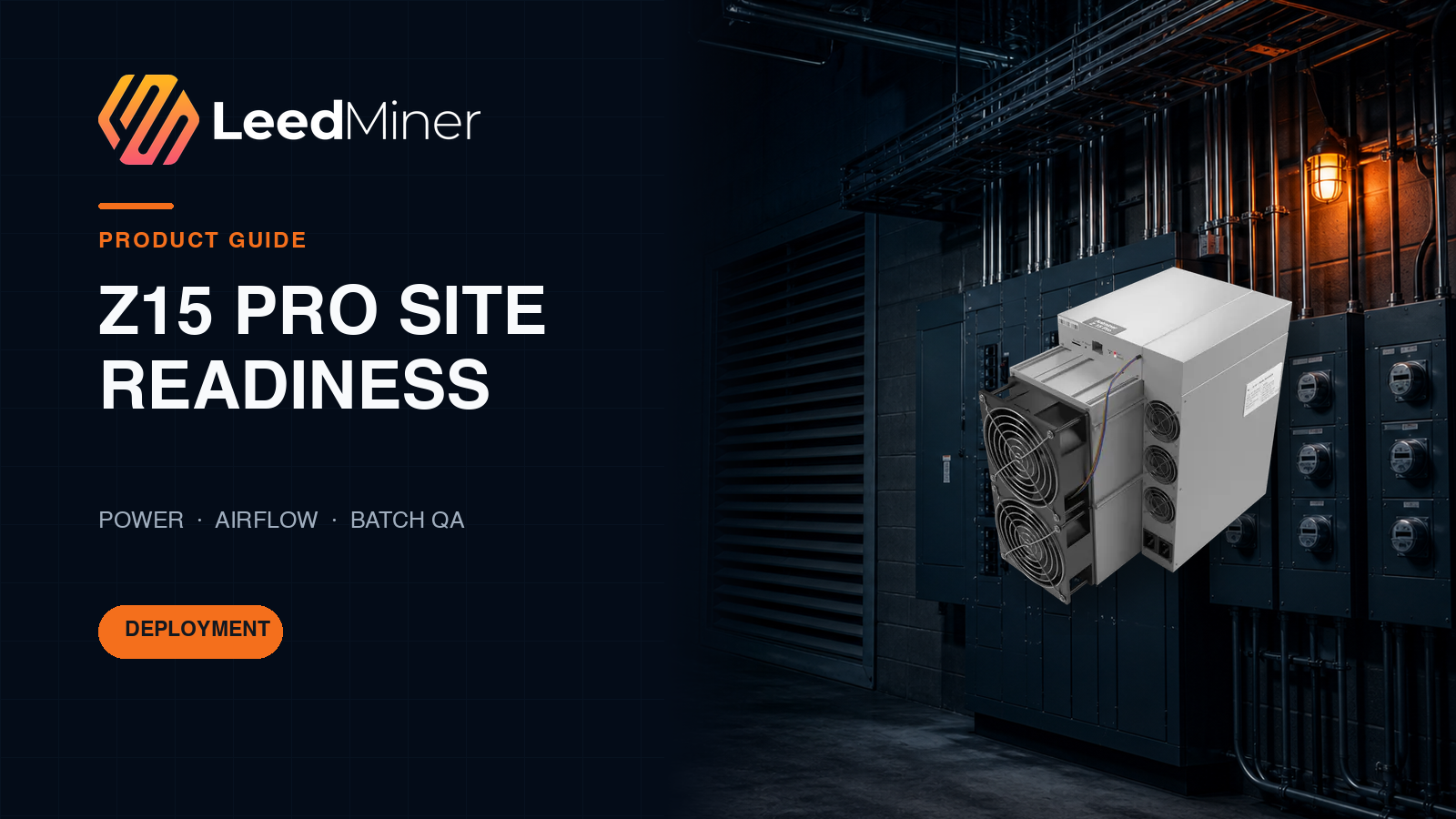
An Antminer Z15 or Z15 Pro deployment should begin with an exact batch record, not a headline hashrate. BITMAIN’s current specification pages define nominal values and tolerances, while the LeedMiner catalog may contain distinct new or used bins with their own hashrate, wall-power and condition records. The practical job is to reconcile those records before procurement, then prove the electrical, airflow and pool configuration with one unit before a larger rollout.
This guide focuses on the published, visible and in-stock Equihash models shown below. It does not reproduce sales prices or promise a fixed return. Network difficulty, coin value, pool policy, uptime, rejects, repairs and electricity all move independently. Use current operating data and a documented shutdown threshold rather than treating a supplier snapshot as a forecast.
Key takeaways
- Match the exact model, hashrate bin, condition, power input and serial paperwork before site design.
- BITMAIN lists the Z15 Pro at a typical 840 KSol/s and 2,780 W at 25°C, with stated hashrate and power tolerances.
- Continuous-load circuits, voltage, cable count, exhaust separation and ambient derating matter as much as nameplate efficiency.
- For used equipment, inspect contamination, fans, boards, connectors, firmware and repair history before acceptance.
- Commission one worker, verify accepted hashrate and thermal stability, then scale in controlled groups.
Verify the exact batch against official Z15 specifications
Start with the manufacturer’s Z15 Pro specification and Z15 series specification. BITMAIN identifies the Z15 Pro as an Equihash unit for ZEC and ZEN, with a typical 840 KSol/s, 2,780 W at the wall at 25°C and 3.31 J/KSol. The same document states that actual hashrate can vary by ±3% and wall power and efficiency by ±5%. For the earlier Z15, BITMAIN lists 420 KSol/s, 1,510 W and 3.6 J/KSol. These are engineering references, not a substitute for the label and test record of the unit being delivered.

A catalog bin above the nominal figure can be legitimate when it remains inside the manufacturer’s stated tolerance, but the operator should never infer a bin from the model family alone. The LeedMiner Z15 Pro 860 KSol/s record, for example, is a specific catalog configuration with 2,847 W and 3.31 J/KSol. Confirm that the shipping label, serial list, test sheet, PSU arrangement and firmware correspond to that configuration. Do the same for the 840 KSol/s record rather than assuming every Z15 Pro is interchangeable.
Condition is another hard boundary. A used Z15 420 KSol/s has the same algorithm and nominal operating envelope as its family, yet acceptance needs additional evidence: fan hours where available, dust or corrosion, hashboard count, connector discoloration, repair marks, abnormal logs and a sustained test. Photograph every side, record serials and compare local hashrate with pool-side accepted hashrate. A short power-on video does not establish stability.
The Zcash protocol specification documents Equihash proof of work, but algorithm compatibility does not guarantee that a particular pool, firmware build or coin endpoint is current. Verify the pool’s official domain, supported chain, payout rules, regional endpoint and maintenance status. Keep wallet credentials outside the miner management interface and use a unique worker name for the burn-in unit.
Antminer Z15 420 KSol/s - Used

Air cooling · 1,510 W · 3.6 J/KSol · In stock
Antminer Z15 Pro 840 KSol/s

Air cooling · 2,780 W · 3.31 J/KSol · In stock
Antminer Z15 Pro 860 KSol/s

Air cooling · 2,847 W · 3.31 J/KSol · In stock
Use the LeedMiner comparison tool to line up exact records. Before ordering, request the final batch identity, condition, quantity, input requirement and testing evidence so the electrical plan matches what will arrive.
Engineer continuous power and airflow before delivery
BITMAIN specifies a 200–240 V AC input range for the Z15 Pro, 50–60 Hz frequency, 20 A input and two AC inputs at 10 A per wire. Those values make voltage and connector planning a precondition, not a post-delivery task. Have a qualified electrician size branch circuits, breakers, conductors, receptacles and distribution for continuous operation under the applicable local code. Reserve headroom for the manufacturer’s wall-power tolerance, ambient conditions, conductor temperature and other loads on the same distribution path.
Do not multiply a nominal wattage and stop. Document phase balance, breaker positions, cable length, connector rating, PDU limits, grounding, surge protection and emergency isolation. Measure voltage at the equipment position under load. An unloaded reading at the panel will not reveal connector heating, voltage drop or a shared-circuit bottleneck. Thermal-scan plugs, receptacles and breaker terminations during burn-in, then retain the images with the commissioning record.
Every watt entering the miner becomes heat that the room or enclosure must reject. Separate clean intake from hot exhaust, prevent recirculation and calculate airflow from measured temperature rise rather than fan count alone. BITMAIN lists a 0–40°C working range and 10–90% non-condensing humidity for the Z15 Pro, while its altitude note reduces the highest operating temperature above 900 m. Treat those limits as boundaries; stable operation normally needs margin inside them.
Filter design must balance contamination control and pressure drop. Establish a baseline for inlet temperature, exhaust temperature, fan speed, board temperatures and room pressure with clean filters. Then set inspection and replacement triggers. If filters load, intake temperature rises or exhaust short-circuits back to the inlet, fan speed and noise can climb while stability falls. A larger facility should map hot spots at multiple rack heights instead of relying on one wall sensor.
For a modular or container deployment, keep the same electrical and airflow evidence but review it as a complete system. The container solutions pathway is appropriate when switchgear, intake, exhaust, fire protection and service clearances must be engineered as one transportable package. If on-site power or staffing is not ready, compare the requirements with hosting rather than energizing equipment in a temporary room.
Stage commissioning and keep operating evidence
Commission one unit first. Record the exact serial, catalog record, firmware source, firmware version, pool endpoint, worker name, wall power, inlet temperature, exhaust temperature, fan speed, local hashrate and pool-side accepted hashrate. Check rejected and stale shares, reconnects and board-level errors over a meaningful burn-in window. The goal is not a single peak reading; it is a stable operating band that the site can reproduce.
Validate pool failover with a controlled test. A backup URL that has never been exercised is only a configuration claim. Confirm DNS resolution, network routes, account settings and worker visibility on the secondary endpoint, then return to the primary path and document the timestamps. Protect management access on a dedicated network segment, change default credentials, restrict administrative reachability and keep firmware files tied to the manufacturer’s support channel.
Scale in groups that the electrical and ventilation system can observe. After each group, recheck phase balance, breaker temperature, connector temperature, inlet distribution, exhaust recirculation, noise and rejected shares. Stop the rollout when a measured boundary moves outside the approved band. That pause is cheaper than discovering a systemic power or cooling problem after every position is full.
Build a maintenance baseline during commissioning. Photograph clean heat sinks and connectors, record fan acoustics, retain the first stable log and define the inspection cadence for dust, filters, cable strain, abnormal LEDs, fan vibration and hashboard errors. For used units, shorten the first inspection interval. Keep replaced parts and repair actions linked to serial numbers so repeated failures can be separated from site-wide airflow or power issues.
Operating economics belong in the same evidence file, but not as a fixed public promise. Use current network difficulty, current coin and pool data, actual accepted hashrate, actual uptime, measured kWh, pool fees, maintenance and liquidity assumptions. Recalculate when the network or site changes, and define the action triggered by a negative margin. Hardware efficiency is an input; it is not a guaranteed outcome.