



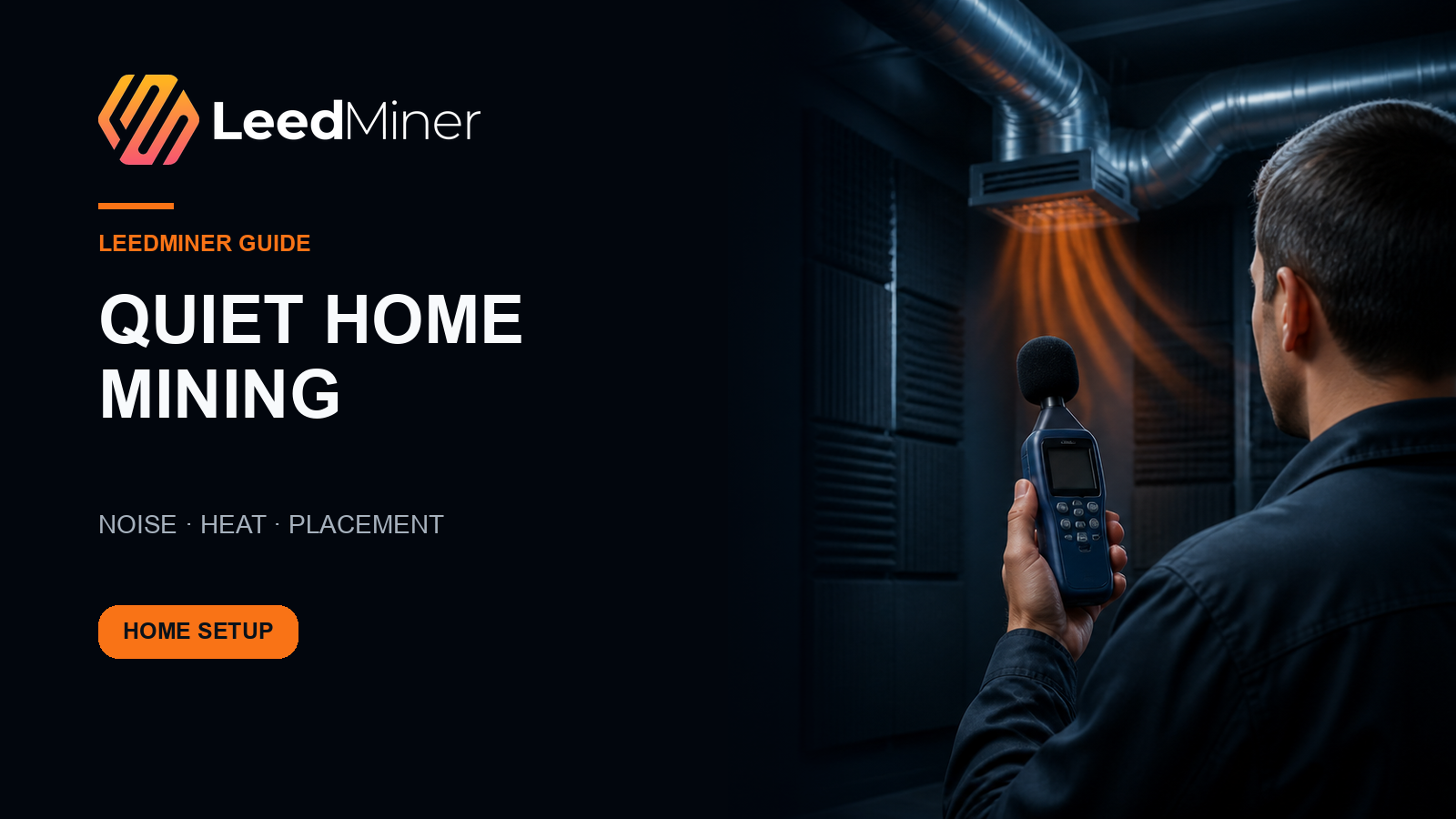
Home ASIC mining is often presented as a hardware decision, but the installation usually succeeds or fails on three building questions: how much sound reaches occupied rooms, where continuous heat goes, and whether the electrical and ventilation paths remain safe in every season. A machine that looks quiet on a specification sheet can still be intrusive through a lightweight door, rigid duct, or vibrating shelf. A compact unit can also add as much heat to a room as a space heater.
This guide explains how to evaluate noise, heat, and placement before choosing equipment. It is not a substitute for local electrical, fire, ventilation, or building requirements. Use manufacturer limits for the machine, measure the finished room, and have qualified trades review permanent wiring and duct penetrations.
Measure noise where people actually hear it
Decibels are logarithmic, so a small numerical change can represent a large change in acoustic energy. The U.S. National Institute for Occupational Safety and Health notes that a 10 dB increase represents ten times more sound power. It also recommends an occupational exposure limit of 85 dBA averaged over eight hours, with allowable time halved for each 3 dB increase. OSHA uses a different workplace limit of 90 dBA over eight hours and a 5 dB exchange rate. These are occupational hearing limits, not targets for bedrooms, living rooms, or neighbors.
A manufacturer noise rating is useful for screening, but it does not describe the finished home. The result depends on distance, fan speed, room reflections, ambient temperature, operating mode, and the measurement method. Measure A-weighted sound near the machine for maintenance planning, at the closed utility-room door, in the nearest occupied room, at the property boundary, and during the quietest night period. Record the operating mode and room temperature with every reading.
Airborne fan noise is only part of the problem. Structure-borne vibration can travel through a shelf, joist, wall bracket, or rigid metal duct and reappear as a low-frequency hum elsewhere. Begin with source control: select equipment designed for home use, keep filters and airflow paths clean, and avoid forcing fans to run faster because of hot intake air. Then add resilient feet or a properly rated isolation platform, a solid door with perimeter seals, and lined ducts with gentle bends. Never trade away required airflow or fire safety for acoustic foam.
Use a baseline-before-change method. Take readings with the room off, with ventilation running, and with the miner at each approved mode. After any enclosure or duct change, verify both sound and inlet temperature. A quieter result that raises chip temperature or restricts exhaust is not an improvement.
Treat every watt as heat and design a year-round path
Almost all electrical input to a home miner becomes heat in the building or exhaust stream. A 630 W device behaves roughly like a small continuous heater; an 800 W device adds more; a 1,626 W unit can dominate a small room. The useful winter effect may be welcome, but the same load can create overheating in mild weather or summer. Plan the heat path before the equipment arrives.
Start with a simple room heat balance. Compare equipment watts with the room's heating requirement, outdoor temperature, ventilation rate, and any other appliances. For air-cooled equipment, provide a clean intake and a low-resistance exhaust route that prevents hot air from recirculating into the inlet. Weather hoods, backdraft dampers, insect screens, condensate control, and fire-safe wall penetrations must suit the local climate and code.
Heat reuse works best when source and demand occur at the same time. Warm exhaust can serve a workshop, garage, drying area, or another suitable space, but it should not carry dust or create pressure problems in occupied rooms. The U.S. Department of Energy describes heat recovery as useful when heat supply and demand are synchronized. It also emphasizes whole-house review of the envelope, mechanical systems, electrical loads, ventilation, moisture, and safety. For hydronic projects, follow the dedicated home heating mining system design guide; for broader reuse concepts, see Bitcoin mining heat reuse.
Always define the zero-demand state. If the home needs no heat, the system must still reject the full equipment load without an open door, improvised fan, or unattended window. Add temperature alarms and an automatic safe shutdown for failed exhaust, blocked intake, excessive room temperature, or loss of network control. If a residential site cannot provide acceptable acoustics, ventilation, and power, professional hosting may be the more predictable operating model.
Choose the machine and placement as one system
Shortlist equipment only after defining the room limits: available voltage and circuit capacity, maximum continuous watts, acceptable sound in nearby rooms, required airflow, winter heat demand, summer rejection capacity, network access, and maintenance clearance. Manufacturer modes matter. Canaan explains that the Avalon Mini 3 separates heater, mining, and night operation, and that higher-performance mining mode may produce more fan noise. The correct comparison is therefore machine plus mode plus room, not a single headline decibel value.
On August 26, 2026, the following exact LeedMiner catalog records were published, visible, in stock, and equipped with approved primary media. Their catalog specifications make them useful reference points for different home-load ranges. Confirm the current product page, voltage, operating modes, warranty, and site conditions before ordering.
Canaan Avalon Mini 3 37.5 TH/s
Air cooling · 800 W · 21.3 J/TH · In stock
Commission in stages. First verify the dedicated circuit, grounding, disconnect, cable temperature, and measured voltage under load. Next run the empty ventilation system and confirm airflow direction, noise, and weather protection. Install the vibration platform and seal the room. Then operate the miner at its lowest approved mode, log inlet and outlet temperatures, and measure sound at every listening point. Increase performance only after the room remains within limits for a complete daily temperature cycle.
Keep a simple operating log with watts, mode, room temperature, inlet temperature, sound at the nearest occupied room, rejected shares, and shutdown events. Recheck after filter cleaning, fan replacement, duct changes, or seasonal damper changes. This turns a one-time setup into a controlled residential system.
Key takeaways
- Use catalog decibels for screening, then measure the completed home at the listener position.
- Separate airborne sound from structure-borne vibration and control both without restricting cooling.
- Treat equipment watts as continuous heat and design both winter reuse and summer rejection.
- Select the machine, operating mode, room, electrical circuit, and ventilation as one system.
- Start at the lowest approved mode and commission with temperature, airflow, and sound records.
Sources
- CDC/NIOSH: Understanding Noise Exposure Limits
- OSHA: Occupational Noise Exposure
- Canaan: Explanation of Avalon Mini 3 Modes
- Canaan: Avalon Mini 3 Specifications
- FLUMINER: T3 Official Specifications
- U.S. Department of Energy: Whole-House Weatherization
- U.S. Department of Energy: Waste Heat Management