


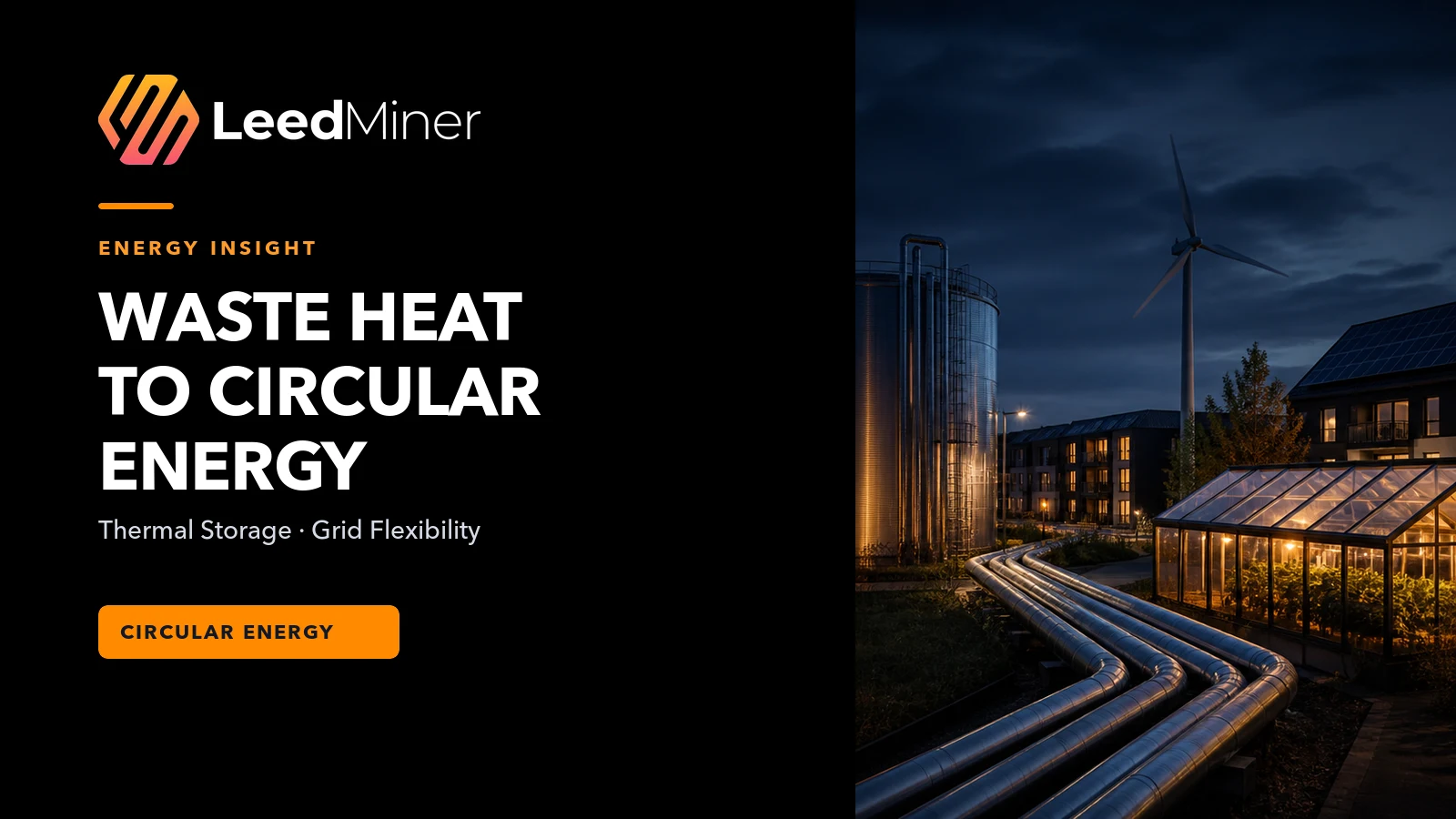
Energy circularity means keeping energy useful for as many stages as possible before it is finally rejected to the environment. Bitcoin mining can participate in that model when it is located beside a real heat demand, operated as a controllable electrical load and integrated with thermal storage. The miner consumes electricity and secures the network; its heat can then warm a building, water loop, greenhouse or district network. Storage and controls align the timing of electricity use, computation and heat demand.
This is a system-level opportunity, not a claim that every mining project is sustainable. Results depend on the electricity source, network constraints, miner efficiency, local heat demand, temperature level and the alternative heating technology. A credible circular-energy project measures each boundary and reports both benefits and losses.
From a linear energy path to a circular one
In a linear configuration, electricity enters an ASIC facility, computation is performed, and fans or dry coolers reject heat outdoors. In a circular configuration, a liquid-cooling loop captures the thermal output and transfers it to another process. The same electricity still powers the miner, but less additional energy may be needed for the receiving heating load.
The most important design variable is co-location. Heat is expensive to transport over long distances, particularly at low temperature. The International Energy Agency identifies proximity, recoverable temperature and matching demand as central factors for data-center heat reuse. A small home system has an advantage because the source and load are on the same property. A larger project needs heat mapping and a customer or process that can accept the output for many hours.
Useful destinations include space heating, domestic-water preheating, pools, greenhouses, warehouses and low-temperature district systems. The Bitcoin Mining Heat Reuse guide covers the building mechanics; LeedMiner's Home Heating Mining systems show how compact packages can place source and load together.
Thermal storage connects steady mining with variable heat demand
Mining can operate steadily while building demand changes minute by minute. A buffer tank absorbs that timing difference. It stores hot water when miner output temporarily exceeds demand and discharges when zones call for heat. The U.S. Department of Energy describes thermal energy storage as a way to reserve heat for later use, support reliability and balance supply with demand.
Storage does not create energy and it does not remove seasonal mismatch. A residential tank normally shifts heat across minutes or hours. Large water pits, boreholes or underground stores can shift energy across much longer periods, but those are district-scale infrastructure projects. Each design should state its usable storage capacity, temperature range, standing loss and maximum charge/discharge rate.
A thermal meter should calculate recovered heat from measured flow and temperature difference. That value is more meaningful than assuming that every electrical kilowatt-hour was delivered to the building. Pumps, heat exchangers, pipe loss and heat rejection all affect the final energy-reuse factor.
Flexible mining can follow energy-system conditions
ASIC mining is operationally different from many industrial processes because computation can often be reduced or paused without damaging work in progress. Research has modeled cryptocurrency mining as a flexible load in microgrids and as a controllable resource coordinated with renewable generation. This does not make mining equivalent to a battery: a battery returns stored electricity, while flexible mining converts electricity into computation and heat. The useful comparison is controllability, not electrical round-trip storage.
Controls can schedule higher output when electricity is abundant, network conditions permit and heat demand or storage capacity is available. They can reduce output during grid peaks, high tariffs or high tank temperatures. The economic signal must be combined with safety limits and current mining profitability. A project that ignores hashprice or assumes permanent grid availability will overstate flexibility.
For miners who prefer off-site operation, hosting may offer professional power and cooling management, but heat reuse still depends on the host's local thermal customers and infrastructure. For on-site projects, the large-load grid flexibility guide explains electrical scheduling considerations.
Heat pumps and low-temperature networks extend reuse options
Recovered water may be warm enough for radiant floors yet below the supply temperature needed by older radiators or district networks. A heat pump can lift that temperature. The IEA notes that heat pumps enable otherwise low-temperature waste streams to serve district heating. The best system minimizes the required lift by selecting low-temperature emitters and maintaining a useful miner outlet temperature.
Heat-pump electricity, pump power and auxiliary cooling must be included in the energy balance. A higher delivery temperature can expand the market for recovered heat but reduce system efficiency. Engineering should therefore begin with the lowest temperature that meets the user's need.
At district scale, policy is also moving toward measured heat recovery. The EU Energy Efficiency Directive requires data centers above specified thresholds to assess and, where feasible, use waste heat. The directive is not written specifically for Bitcoin mining, but it shows the direction of sustainable-computing metrics: energy efficiency, renewable supply, cooling performance and waste-heat reuse are evaluated together.
Measure circularity with an auditable boundary
A strong project dashboard separates six values: miner electricity, auxiliary electricity, computational output, heat captured, heat delivered and heat actually used. It also records the carbon intensity and price of electricity over time. Avoided heating emissions depend on what the recovered heat replaces; displacing a resistance heater is different from displacing a high-performance heat pump.
Useful indicators include heat recovery rate, heat utilization rate, energy reuse factor, seasonal hours of useful heat, auxiliary electricity per delivered thermal kilowatt-hour and forced-rejection hours. The business dashboard should additionally separate mining revenue from avoided heating cost. This prevents double counting and makes sensitivity testing transparent.
Run scenarios for warm weather, low mining revenue, high difficulty, equipment downtime and zero heat demand. Circularity is strongest when the system still has a safe operating mode in every scenario and when the financial case does not depend on a single optimistic input.
Equipment reference for a circular heat loop
A hydro miner can provide a measurable thermal source, but the circular-energy value comes from the system around it: exchanger, storage, controls, heat customer, backup and rejection capacity. For a component-level design sequence, use the Home Heating Mining System Design Guide. For renewable-supply context, read Renewable Energy's Impact on Mining.
Project decision checklist
- Is there a nearby heat user with a documented temperature and schedule?
- What percentage of annual miner heat can actually be used?
- How much short-term thermal storage is available?
- What happens at zero heat demand?
- Can mining output respond to tariffs or grid events within equipment limits?
- What heating technology and emissions are being displaced?
- Are recovered heat and auxiliary electricity metered?
- Does the business case survive conservative mining and heat scenarios?
Sources
- IEA: Opportunities for district heating in the changing energy landscape
- U.S. Department of Energy: Thermal Energy Storage
- U.S. Department of Energy: Zero Energy Districts and Communities
- International Journal of Electrical Power & Energy Systems: Cryptocurrency mining as a novel virtual energy storage system
- EU Energy Efficiency Directive 2023/1791